
Oliver Larkin Wants to End the "Reflexive Moderation" of Florida Democrats
The DSA's Congressional candidate in South Florida says his state is ready for the revolution.

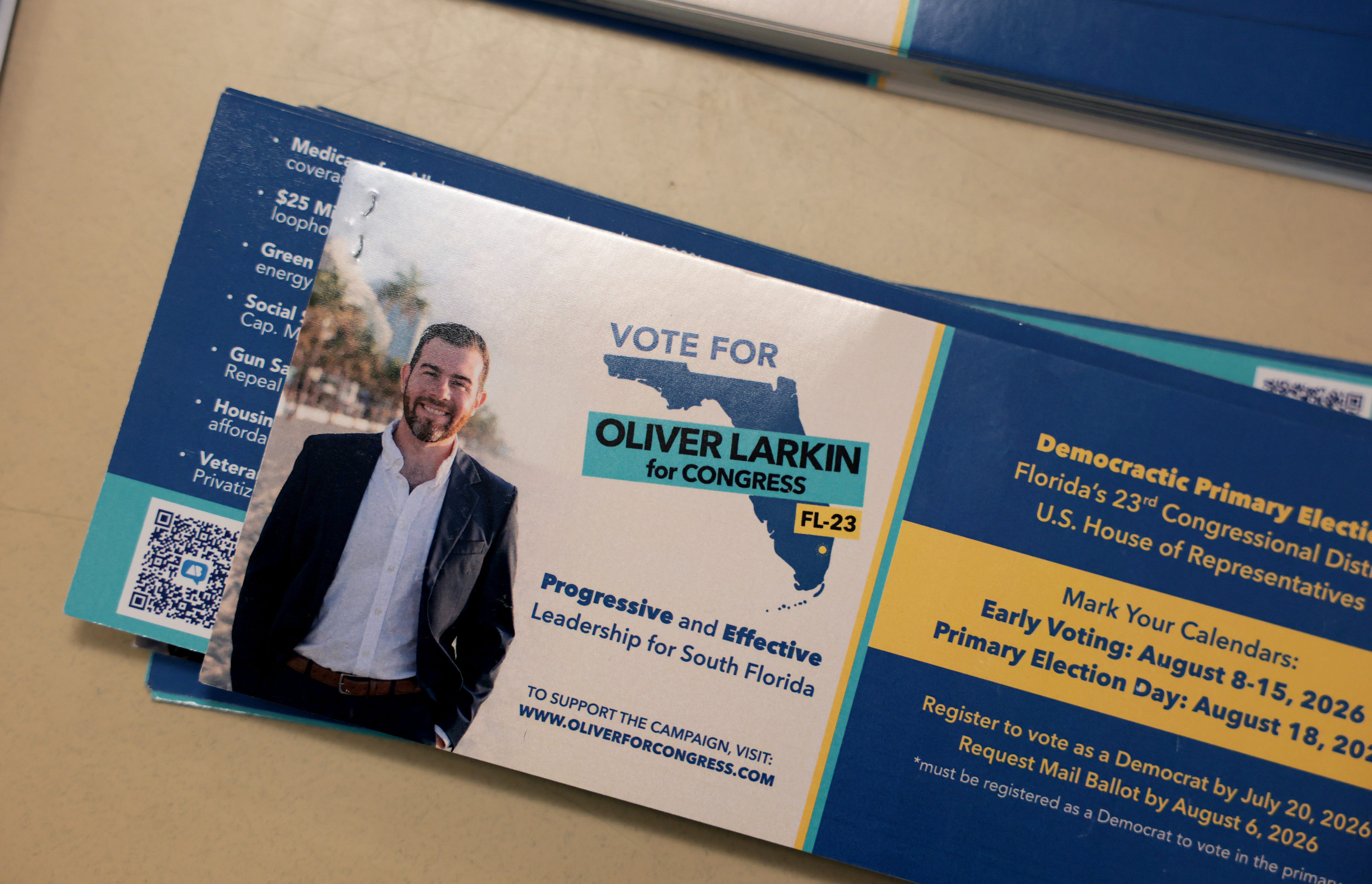
This will go down as the year that the Democratic Socialists of America introduced themselves to national politics in earnest. Following a string of victories by DSA-aligned candidates in Congressional races from New York to Colorado, the Democratic establishment finds itself scrambling to adjust to a new reality. Next week, Oliver Larkin will become the first DSA candidate to try to unseat an incumbent Democratic Congressman in the state of Florida.
Larkin, a Florida native, worked in progressive politics in DC and elsewhere (and helped to unionize his workplace along the way) before moving back to South Florida in 2022. He is running against Jared Moskowitz, a staunchly pro-Israel centrist Democrat, setting up a clear contrast between the two candidates. I spoke to Larkin about Israel, climate change, organized labor, and whether DSA can revitalize the broken Florida Democratic Party. Our conversation is below.
How Things Work: Why did you decide to run? After growing up in Florida, what made you think it’s plausible for a guy like you to win a race like this?
Oliver Larkin: I was away for a couple of years. I worked on the Sanders campaign in 2016, and then went to DC and worked with a number of progressive groups, including the organization inspired by his campaign, Our Revolution. I came back during Covid… I think of it as a ten year arc from when I was inspired to join the Sanders campaign before Trump was even elected. Just the kind of gridlock and inability of the two Obama terms to deliver on the kind of change that people were hoping for, that inspired me to get involved in organizing and progressive politics and democratic socialism. And then seeing how all that energy was metabolized into electing Biden in 2020, and then maintaining these very milquetoast policies that were not actually directly improving the lives of working people during the Biden administration. After Democrats lost in 2024, I was like “I cannot continue to honestly engage with this party unless I really say what’s necessary, to my mind.” We’ve seen in Florida the state go so far to the right in recent years, and that’s coincided with the elevation of these very conservative Democrats like Jared Moskowitz. So when I looked at the fact that he was unchallenged in the primary in 2024, and then everything he did—joining DOGE, voting for the Laken Riley Act—it became clear to me that if I did not step up, I did not think anyone else was going to run against him. I’m the only candidate running against him right now.
Florida was almost a 50-50 Democrat and Republican state not long ago. Ron DeSantis barely got elected to his first term. Obama won Florida. Now, that’s not the case. How did the Florida Democratic Party get so weak so fast?
Larkin: We’re seeing a few issues in the Florida Democratic Party. The anti-blackness issue, where when we had a black statewide nominee named Andrew Gillum, who was running [for governor in 2018] on Medicare for All and a progressive platform, that was very inspiring to a lot of people. But now we see Debbie Wasserman Schultz going into the [black majority] 20th district. We see the Senate establishment, Chuck Schumer, trying to handpick Alexander Vinman over a working class union organizer like Angie Nixon. This reflexive moderation that the Florida Democratic Party has had to nominate Charlie Crist twice, after he was elected as a Republican. Jared Moskowitz is another example.
When Florida passed a $15 minimum wage amendment in 2020 with 60-plus percent of the vote, the Florida Democratic Party treated it at arm’s length distance. They couldn’t even really just say “we believe that you deserve a living wage”—and I don’t necessarily think $15 an hour is a living wage these days, that’s why I’m running on $25. But I think the Florida Democratic Party is so dominated by corporate interests. When Florida Power and Light is raising Floridians’ utility rates by $7 billion, and then they’re a key sponsor of the Florida Democratic Party’s gala every year, of course you’re not going to have Democrats that are speaking out against the corruption of power utilities and the influence of money in politics. I think they just take for granted that it’s a big state, it’s expensive to advertise in, and so they have to make these deals with the devil.
Florida is an elastic state. It’s not static the way that many other states are. Florida can have big swings depending on who’s inspired to turn out and what kind of coalitions you’re mobilizing. That’s why I think there’s a lot of opportunity with our race, to mobilize a new kind of coalition.
I’ve always thought Florida had a lot of opportunity for unions—a big service economy, a tourist economy, a lot of places to organize at economic choke points. You’re a big pro-labor guy. What’s your vision for building union power in Florida?
Larkin: It has to be done in tandem with solidarity with the immigrant community… when DHS invalidates [Temporary Protected Status], or when the Trump administration or the Biden administration go after immigrants, that impacts union membership, and there’s a ripple effect there. Where if you’re having your union members laid off en masse, if God forbid they’re getting deported, that’s less power for the union to collectively organize and flex its muscle.
I think as well the opportunity exists in Florida in the hospitality sector. I’m not the only labor organizer on the campaign— my campaign manager is a former Unite Here Local 355 staff organizer, who organized the Miami Beach Convention Center. There is so much opportunity here with the tourism economy, with the transportation sector… and doing that in tandem with efforts like raising the minimum wage to a living wage and passing Medicare for All. We want to take some of these things that should be collective benefits for every single American, get those taken care of so that unions don’t have to leverage their health care benefits to the deficiency of some other benefit that they might be organizing for.
Unions—regardless of who’s in power in Congress or the state legislature—this is one lever of power that the working class has regardless of who’s in office, to extract some real material concessions through collective bargaining.
In Florida, the racism that is driving the anti-immigrant policies of the current administration is running up against the business realities of the agriculture industry and other industries. Do you think there’s an opportunity to split that coalition in Florida that forms the base of political support for the ongoing persecution of immigrants?
Larkin: I think so. There’s one individual that has been making the rounds online. He’s a Haitian man, a business owner, he owns a chain of restaurants called Chef Creole. He’s been in the news recently because he’s going to have to shutter two of his restaurants because his kitchen staff, the restaurant staff, is overwhelmingly Haitian Americans on TPS. And he voted for Trump. He said, “I thought Trump was gonna be good for my business, now I’m shutting it down.” We’re seeing that happen more often with the Cuban community, that traditionally has been very anti-socialist, anti-communist, yet they’re also being scooped up by ICE.
A lot of the right’s attacks on democratic socialism or progressive issues, they use the S word, they use the C word, they really try to fearmonger. But what people are really concerned about, what people think of when they think about authoritarianism and repression, it’s the repression of civil and political rights. It’s the inability to have the freedom of protest, or even basic freedom of speech. What we’re seeing from this current administration is that a lot of the fearmongering that’s done about left politics or democratic socialism or progressive values—we’re actually seeing the things that they’re fearmongering about emanating from the political right and from the Trump administration.
In a lot of the DSA Congressional races in New York, Israel was a decisive issue. Jared Moskowitz is extremely pro-Israel. How big of an issue has Israel been in your race?
Larkin: It’s an enormous issue. I would dare say it’s one of the biggest issues. In the last couple of days, the Miami Herald editorial board, the Sun-Sentinel, have written stories that they’ve been relentlessly promoting about me running as an anti-AIPAC candidate, as an explicitly anti-Zionist candidate, against an incumbent who asserts that I’m running against him solely because of his religion. The South Florida Sun-Sentinel editorial board said that’s patently false, it’s easily disproven, that we have key [policy] differences… there’s so many issues that Jared Moskowitz and I disagree on. But it’s his prerogative to make it about identity politics. And I think he’s doing that very intentionally, because our district is the second most heavily represented Jewish-American district in the country.
With respect to AIPAC—or with disrespect to AIPAC—they pull the United States in this direction where we’re now spending $1 to $2 billion a day, and we’re sending billions of dollars annually to Israel, which has heavily subsidized or universal health care and college education. As our cost of living is growing exponentially higher, it is a bitter pill for people to swallow to see that there’s never a question of sending hundreds of millions of dollars for another foreign war. But when the question is why we’re not expanding healthcare, why we’re cutting Medicaid, or why there’s no affordable housing, or why there’s no investments in public transportation—people are no longer separating domestic and foreign policy. It’s all of a piece together. I think that’s why, with the wave of progressive victories across the country and democratic socialist candidates winning, that we’re seeing this come to a head here in our district. What we find is that the majority of people, regardless of their religious or ethnic background, they’re opposed to AIPAC. They want to see the United States at minimum condition aid to Israel, if not cease aid entirely.
I grew up in Florida and a lot of my family still lives by the beach. The rising cost of homeowner’s insurance is becoming a crisis in Florida. Given the fact that that crisis is fundamentally driven by climate change, what’s the answer? Is there a legislative solution?
Larkin: I think we need a federal homeowners insurance guarantee. In Florida, we’ve seen round about two dozen private homeowners insurance companies leave the state. They’re suffering severe liquidity and insolvency issues… over on the Gulf, there are homes that still have tarps on the roofs three or four years after a storm rolled through. A private insurer would have its entire liquidity wiped out by the claims following one storm. The juice is not worth the squeeze for them.
This should be a state issue. I think there’s a federal solution, but it’s because the state has abdicated its responsibility. Desantis is heavily supporting this Amendment 3 to abolish property taxes. They’re doing a hidden ball trick where people are concerned about property insurance and Desantis is like, “What if we just got rid of your property tax instead?” Even though that funds the fire department, the community health centers, the public libraries, any number of things that our society relies on.
We’re experiencing this because of climate change all across the country. People, even if they file a claim, sometimes their rates go up, or they’ll just get dropped from their insurance. We need a federal solution. I think if we broaden the risk pool—not dissimilar to Medicare for All—if you have the widest possible risk pool, then you can diffuse the costs among the greatest number of people, so the individual impact of a storm isn’t going to cause people’s rates to go through the roof, or wipe out a private insurer.
Looking at the polls in your race—Moskowitz sponsored a poll on July 22 that had him up 36 points, and you sponsored a poll on August 5 that only had him up two points. Where do you think this race stands?
Larkin: He did a lot of polling before we started our paid media advertising, before I went on Fox News and had a viral moment calling out the president and the Epstein class. We’re closing very late, the same way that many candidates across the country have in these primaries… we took this poll that found us within the margin of error, but at the same time, $650,000 in super PAC ads were dropped from a Wall Street-aligned group and an AI group, for Jared Moskowitz. So we still have our work cut out for us. We are being outspent right now, but we are organizing much more vigorously than he is. This was always going to be about the many versus the money.
Every single race involving a DSA candidate now, including yours, is going to be analyzed as a marker for how strong DSA is or can be in national politics. How strong do you feel DSA is in Florida right now? And what would you say to other DSA candidates who want to run in red states?
Larkin: Our South Florida DSA chapters have grown tremendously in the last year and a half. What we’ve seen with the election of Mayor Mamdani in New York was a huge surge in membership and activity. And then with our campaign, the fact that our district now spans across Miami Dade, Broward, and Palm Beach County—we’ve got DSA chapters in all three counties that are leading our volunteer operations, our canvassing. We are training field leads, we’re training canvassing and phone banking leads. We’re giving people the ability to develop their political leadership skills. I think that is going to have a ripple effect that is going to be felt long beyond this individual primary.
I got my start as a campaign organizer. Zohran Mamdani was a campaign organizer before he was a candidate. When I look at the huge need to run DSA candidates or progressive candidates at every level of office… there are so many areas that go undercover, that go uncontested. A corporate-backed candidate will drop some mail and maybe run a TV and before the election, and that’s that. What we’re showing is that we can really mobilize people, and doing it at a scale that can really effect a Congressional race, but that can also lead to the development of new leadership and electing new people all the way down the ballot.
Would you like to see AOC run for president?
Larkin: I think that would be fantastic.
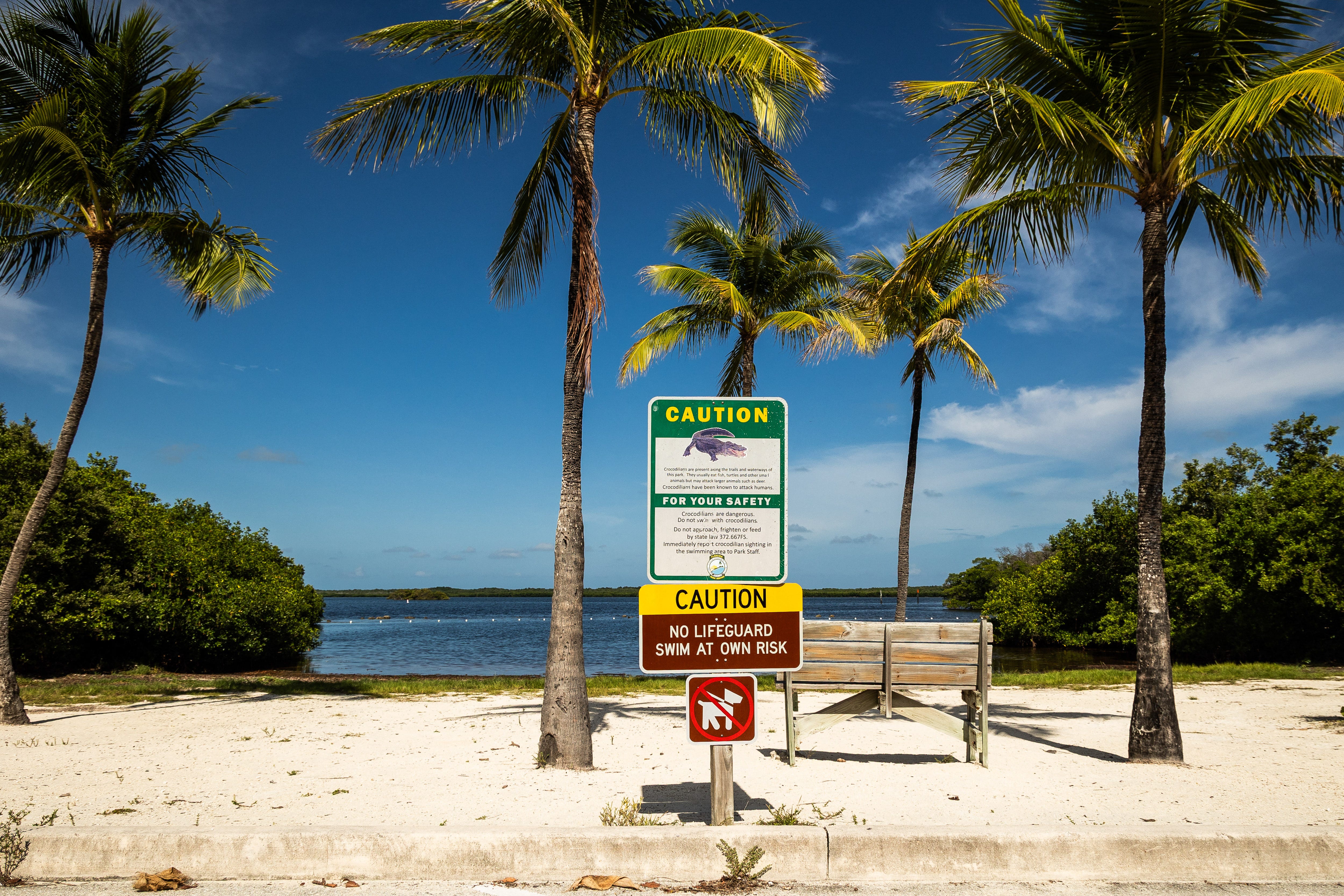
BONUS Florida Lightning Round With Oliver Larkin
What is the single best dish in Florida?
Larkin: Blackened mahi with a squeeze of lemon.
What is the best beach in Florida?
Larkin: I gotta go with Fort Lauderdale beach, my hometown beach.
What is the best Florida tourist attraction?
Larkin: John Pennekamp Coral Reef State Park is breathtaking.
The worst Florida tourist attraction?
Larkin: The Florida State Capitol. Nothing good comes out of there these days.
Who is the most annoying celebrity in Florida?
Larkin: I’m pretty sure Ben Shapiro lives in Boca Raton. He is pretty annoying.
We’re Going Live
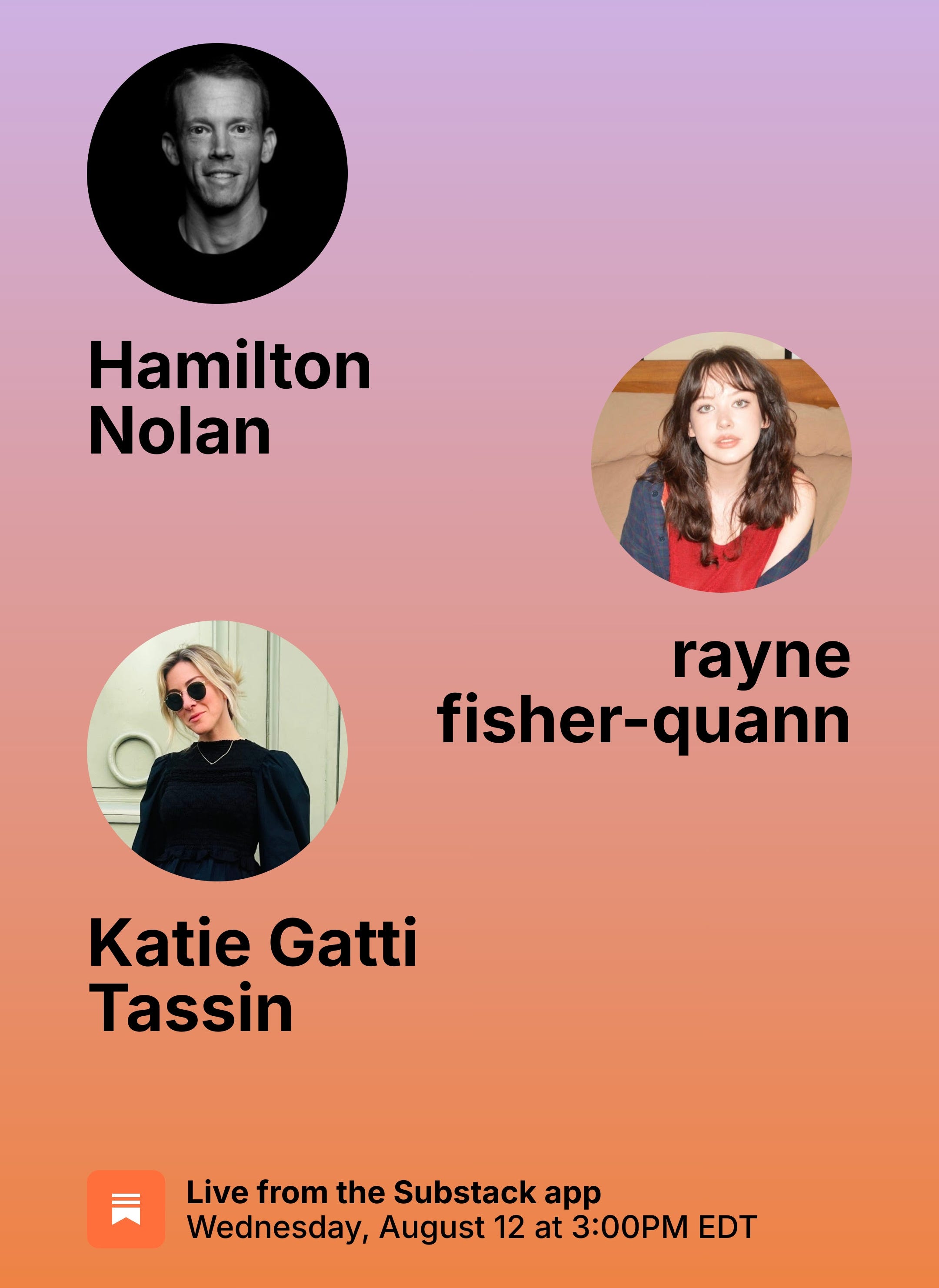
Exciting news: tomorrow, How Things Work will host our first ever Substack Live video discussion—about labor, creators, and what’s next. I’ll be speaking to Katie Gatti Tassin and rayne fisher-quann, two brilliant and very successful Substack creators, about earning a living on Substack, the economics of the media ecosystem, and what it means to think of ourselves as workers in the new creator economy. Join us live online at 3 PM EST tomorrow, Wednesday, August 12. It will be great.
Also
Previously, in How Things Work interviews: Zohran Mamdani; Claire Valdez; Brad Lander; Julie Su; Shawn Fain; Sara Nelson.
How Things Work is 100% funded by readers just like you. We have no paywall, and no ads. The only way we continue to keep on doing what we do is with the support of paid subscribers. To support independent media and help us keep rolling on, take a quick second now to become a paid subscriber yourself. It’s affordable and it comes with great karma. Thank you all for being here.