
Julie Su's Plans for Economic Justice
The former Labor Secretary wants New York City to "show the country a way forward."

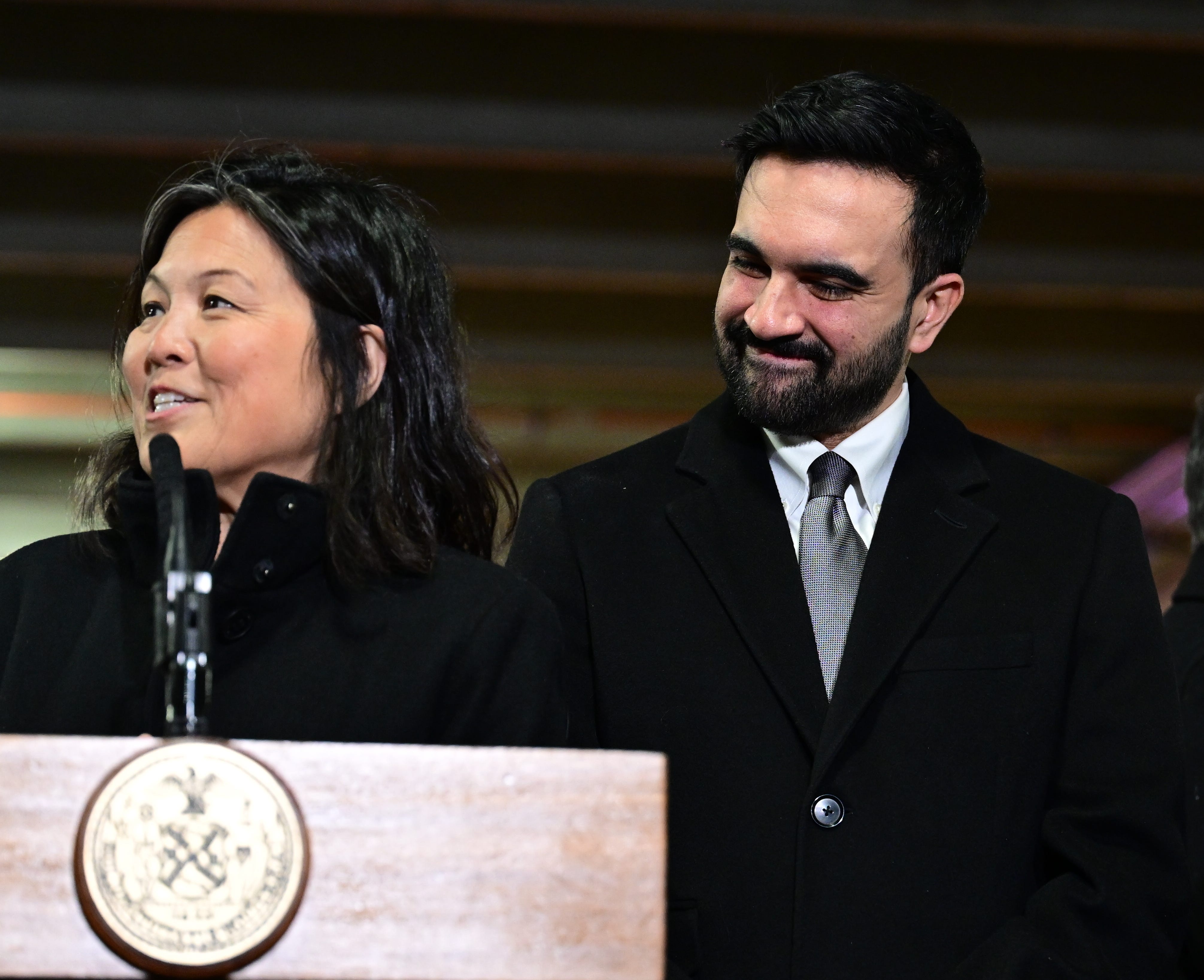
Julie Su was the United States Secretary of Labor for the last two years of the Biden Administration. (Technically she was “acting” Secretary, since Republicans refused to confirm her). She began her career as an attorney fighting for immigrant workers in California, and went on serve as California’ Secretary of Labor under Gavin Newsom before heading to Washington.
Now, she’s come to New York City, where the political action is. Su recently became Zohran Mamdani’s Deputy Mayor for Economic Justice, a job that will allow her to oversee a broad swath of economic and regulatory policy in the city, and to serve as one of the key people tasked with making Mamdani’s political agenda a reality. In a subterranean conference room in City Hall yesterday, I spoke to Su about her plans for the city, helping gig economy workers, immigrant justice, and how to fight for good labor policy at a time when the Trump administration is dismantling everything from above. Our conversation, lightly edited for length and clarity, is below.
Hamilton: Your position, Deputy Mayor for Economic Justice, is newly created. How do you conceive of it? What are your priorities?
Julie Su: Economic justice, right? It is both by definition and by breadth a reflection of this mayor’s commitment to using every tool in this city’s portfolio to make life better for working class New Yorkers. That includes making sure that the laws that protect working people are enforced fully, so that a worker who goes to work at the beginning of the day knows they’re going to come home with all the wages that they earned. It means that we are going to measure the economic health of the city—including its growth, including our development, by how working people do. Whether they benefit from capital investments, or property and real estate. It means that we don’t just want working people to get the basics. We want them to be able to enjoy the full cultural and artistic life of the city. The things that make it a world class city should not be out of reach for the workers that live here.
Based on some of the enforcement actions announced so far, it seems to be both consumer protection and worker protection, is that right?
Su: Well, oftentimes it’s the same people. Workers are consumers and consumers are workers. In New York City, that agency protects both, and that’s not by accident. But we also have broader enforcement. We enforce the human rights laws of the city, making sure that if somebody goes to search for housing or search for a job, they don’t get excluded because of some status. One of the things about this portfolio and putting together various enforcement agencies is recognizing that commonality. We also have small business services under economic justice. Oftentimes, the same corporate entities that exploit working people, either by wage theft or misclassifying them, are the same ones who engage in price gouging and junk fees that hurt consumers, and are the same ones that make it very hard for small business to operate—either through competition, or through creating platforms that small businesses have to pay an enormous amount of their hard earned money to just participate in. So the ability to look at that holistically is the mayor’s vision of not just picking and choosing among the ways that people struggle to make a living.
Are there measurable economic goals that you plan to judge your success by in this job?
Su: I fully adopt the mayor’s goal that we’re going to measure the health of the city by whether it’s affordable for working people. One of those measures will be whether we can reverse the exodus of working people from the city by making it easier to make a living. That includes having child care, a problem that we’ve already begun to deliver on. It means having transit that people can afford so you can do something as basic as get to and from work. It also means increasing what workers keep in their pockets. Part of this is about money, but part of it’s about time. Working people can’t live a decent life or feel secure at the end of the day if they have to work two or three jobs. It’s part of the cruel trick of this idea that stripping workers of protections gives them more so-called “flexibility,” right? If the flexibility is just to go get another job because you can’t live, that’s not flexibility, and it’s actually not well-being.
It’s how much workers make. It’s how much workers have a chance to organize. We are looking at everything that we can do with our tools to support workers organizing for a better life. There are a number of workers who are negotiating for first contracts in New York City. We support strong first contracts for working people who have chosen a union. Our mayor has shown up on the picket line. It’s still too hard to join a union and get a first contract in this country. We want New York City to be different.
Are there policy levers that you can push in this job that will make it easier for workers here to organize and win?
Su: I am taking a hard look at every lever that we may have, and my direction to the entire team under economic justice is that we should unleash our whole power for the good of working people. That means looking at authorities we already have, and dusting off ways that they’ve been interpreted to be narrower or weaker than they should be. It also means understanding that who we see and who we invite into the halls of power matters.
I learned this at the federal level. There are lots of authorities that you can exercise when you are in governing that might not be explicit authorities, but that can really show whose side you’re on—that can demonstrate that workers are at the heart of your agenda. That can be everything from helping to achieve good contracts, to looking at how capital investments go to benefiting people who have always been an afterthought in the past.
My sense is that the business community in New York is still figuring out how to navigate this administration. Have you found them to be nervous about you?
Su: Yes, but mostly I hear that secondhand. This is an all-hands-on-deck moment. We have to have the highest aspirations—which this mayor has been clear about, and which is what swept him into office with a real mandate—and we have to be very pragmatic about what we can deliver. Anybody who’s willing to help us deliver a more affordable New York City, a New York City that does right by its workers, I want to work with them.
The gig economy in New York runs the gamut from food delivery workers to graphic designers to writers. What can people in the gig economy look for from you?
Su: I’m glad you mentioned artists. In the portfolio is the arts and culture—the museums, the libraries, the industries like entertainment and media that make New York City such a world class destination. Looking at that through economic justice is probably about who can afford to participate. But also about, what is the life of artists, and those who create? This problem is not unique to New York City, but many of those jobs have become increasingly insecure for people. Some of that is the evolution of the industry, but it’s also choices that have been made to strip working people of their ability to organize, their ability to be protected by labor laws. Those industries matter a great deal to us, because they’ve already lost a number of protections that were guaranteed to workers for a hundred years.
You just got back from a trip to Thailand. Tell me about that.
Su: About 30 years, in one of my first cases as a young lawyer, I had the incredible privilege of representing a group of garment workers who’d been trafficked from Thailand and forced to work behind barbed wire, and under armed guard, in an apartment complex in Southern California, where they sewed clothes 18 hours a day and were paid pennies for it. When they were discovered by federal authorities, they were thrown into a federal prison and told they were going to be deported. We fought for their freedom from detention. We fought for their ability to stay in this country. One of the first spaces in which I saw that attacks on immigrants are attacks on workers. And we filed a lawsuit against the companies they were sewing for, who disassociated themselves entirely from the operations and said they weren’t responsible, they didn’t know. Our argument was: You are responsible, and it’s not enough to say you don’t know. It’s not enough to close your eyes to the exploitation that you enable and then blame somebody else for it. That case really brought about some changes to this idea of corporate responsibility when you subcontract for labor. [Su’s work on the case eventually helped to win a settlement for the workers, led Congress to pass an anti-trafficking law, and earned her a MacArthur Genius Grant.]
They not only were able to get stability living in the United States, they also went back to Thailand and did things for their families that I think they never imagined. They’ve been asking me to go visit Thailand for—this is a trip decades in the making. Last year, after the Biden administration, I promised them that I now had some time and was gonna go with them to Thailand, so that trip was planned for February.
That case centered on immigrants and labor. Did you take anything from that case that seems relevant to the political atmosphere around immigration today?
Su: In that case, initially, the workers had been trafficked. Their passports had been taken from them. They had been working in the country. When they were rounded up, forced into prison jumpsuits, and told they were getting deported, I saw it as sending a message to all working people who were working under unspeakable conditions, who were regularly threatened by their employers that their immigration status would be weaponized against them, as a message back to all those workers. If this group of workers could be summarily deported, then other workers would be made even more vulnerable too. So it was about this group of workers, but it was about all workers whose immigration status is used to exploit and dehumanize them…
The government is supposed to enforce labor laws, not enable employers in breaking them. We changed policy that would allow workers to come forward when they are being abused and end that exploitation without fear of deportation. So now, fast forward to today, where the machinery of the federal government is being used to send that exact message that working people are criminals—and that the power of the federal government is going to be used to support exploitative employers. It is bad policy. It’s bad for individual workers. It’s bad for our economy. It’s bad for the rule of law.
What’s the experience been like for you over the past year, watching the Trump administration more or less dismantle a lot of what you did in Washington?
Su: Well, it’s disastrous. I think it’s also tragic. One of the lessons of my life’s work is that when working people do well, everyone does better… Working people, when given a shot, transform their communities. They create real security and become key to the economic life of their entire neighborhood. So I think what’s happening is disastrous at the hands of the federal administration, by vilifying immigrant workers. The federal government has decimated communities. Hurt small businesses. You hear about businesses that close because they no longer have their workforce, or they no longer have people coming to the stores and restaurants because people are afraid to leave their homes. That cannot be the America that we are trying to build. You tied this to what we were doing in the Biden administration—President Biden was very clear that the federal government has tremendous power, especially if we use federal dollars to stimulate real growth and to rebuild our infrastructure. And that wasn’t just physical infrastructure, although that was a big part of it—roads, bridges, pipes for drinking water, high speed internet—but it was also, you know, child care infrastructure. Infrastructure that supports families and makes it easier to live. And the reversal of all of those funds, many of them midway or 80% of the way through finishing of projects, has also been really devastating to the union workers who were doing that job, and also what was being built.
A lot of the analysis in the labor world now is that the only real way to do good policy in the near term is on the state and local level. Is that your analysis, too?
Su: I’m never gonna give up on the importance of federal policy. The ripping up of federal union contracts, that’s been disastrous too. Any time you attack working people, you not only hurt those groups of workers, you’re really taking away the basis for security in families, in streets, in neighborhoods, and in our country. You have people who have devoted their lives to public service, and are now completely thrown out of work.
When you dismantle FEMA, the next time there is a federal disaster, everyone is gonna pay for that. When you stop any kind of scientific research, the next time there is a pandemic—or even just the fact that we are seeing a rise in diseases that have been largely addressed through vaccines—you hurt everybody by doing those things. So you can’t give up on the federal government. There’s nothing like the breadth and depth of what the federal government can do. But yeah, when it comes to pro-worker policies, I think cities and states are now demonstrating that they’re going to do everything possible to fill the gaps. And here in New York City, we are gonna show what is possible when government actually aligns with and prioritizes working people. My hope is that that’s not just going to be good for New Yorkers—it’s going to show the country a way forward.
BONUS: Impossible NYC Lightning Round With Julie Su, Who Just Moved to Brooklyn Like One Second Ago

What is the coolest neighborhood in New York City?
Su: You know I can’t choose.
You can choose. You’re a resident.
Su: I’m definitely not going to choose. I’m still learning all of them. Genuinely, I find a cool neighborhood everywhere I go.
I’m gonna put you down for Downtown Brooklyn. Best restaurant in New York City, or just a restaurant you like?
Su: Ooh. What’s a restaurant I like?
City Hall Cafeteria?
Su: No, no no. Well, there is not far from here, I think it’s called Pearl’s Diner, where we as deputy mayors get together just to get to know each other.
Cali or New York City: which has better food?
Su: Stop! It makes it seem like I don’t want to answer questions. Give me any other place and I can choose. California or New York City? You can’t choose between those two.
Alright. You can argue with Zohran about that. Last question: How much should a cart falafel cost in New York City, in an ideal world?
Su: Not as much as it costs now.
[NO MORE THAN SEVEN DOLLARS. THIS IS THE ECONOMIC JUSTICE WE NEED.]
Also
Previously, in How Things Work New York City interviews: Zohran Mamdani; Brad Lander; Tom Scocca. Previously, in NYC politics: Up With Zohran; New York Socialist City; The Subway Is Not Scary.
Springtime is coming. Now is the time to buy a fly How Things Work t-shirt. It looks freaking great.
Thank you for reading How Things Work. In my last essay I wrote a bit about the tough economics of independent media, and I want to especially thank everyone who donated as a result of that post. The deal around here is: There is no paywall on this site, there are no ads, and there are no corporate sponsors. Everyone can read How Things Work for free, regardless of their income. In exchange, I ask that if you like reading, and you can afford to pay, you take a quick second to become a paid subscriber today. It is the noble paid subscribers who make it possible for this publication to exist, for everyone. Join them! Together we will survive and thrive.
If we only had a few million more people like her! Great interview. I hope she's successful, and I hope that you get a chance to interview her again in a year or so. It'll be interesting to see what obstacles and challenges she's dealing with. Change ain't easy.
So many great topics covered in this interview. While it's unlikely all of them will be addressed, it's incredibly refreshing to hear politicians prioritize the needs of people who actually make the city.