
Two Visions
Politics of love, or politics of fear?

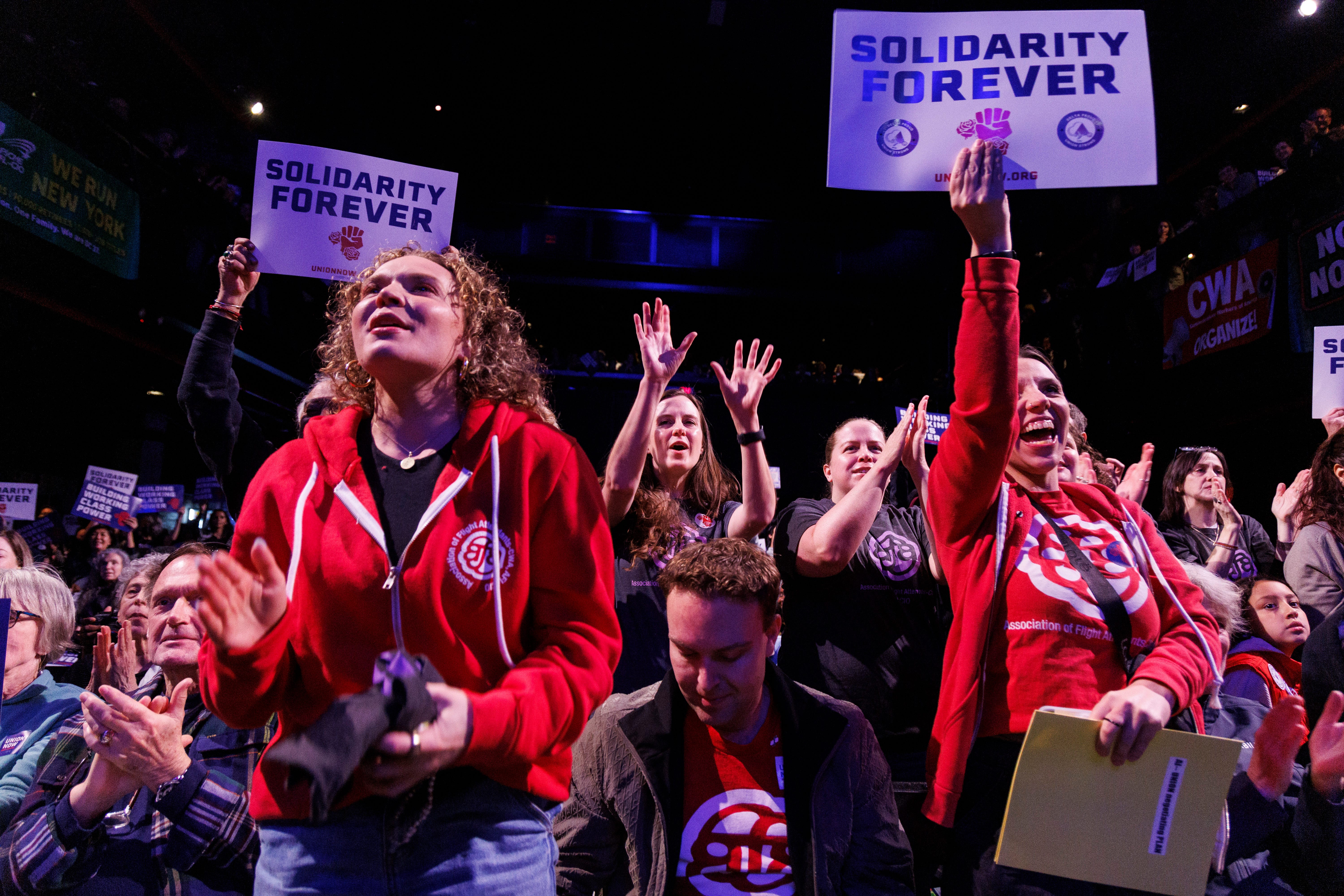
On Sunday there was a big union rally in Manhattan. Zohran Mamdani spoke, and Bernie Sanders spoke, and they were both very good, but in reality, the headliners were there in order to fill up the place so that everyone could listen to the workers speak.
In the heart of the event, about a dozen working people from a whole variety of unions took the stage, one after the other, to give short talks about their own struggles. It is not so common to find yourself in a big crowd at a professionally produced event where everyone is listening intently to regular people. As Studs Terkel proved long ago, regular people often have the most interesting and important things to say.
A Delta flight attendant said: “I’ve had many experiences on the aircraft and abroad that have shown me that my employer will never care about me as much as these flight attendants right here when we share that jumpseat. They’ve done things for me such as giving me safety tips in a new city; helping me get emergency medical equipment while I’m assessing an unconscious passenger on the floor; or even finding me a hotel room when our company has ‘lost me’ in the system, and I’m stranded with no place to sleep.”
A New York City municipal worker said: “Right before Thanksgiving, over 30,000 New Yorkers were at risk of losing Medicaid. Right around the holidays! And what was the cause of this? A failed AI system. It was city workers, union workers, my own DC37 family, that worked overtime throughout the holidays when the system failed us to carry that burden. And our jobs are threatened? We are the expendable ones?”
A special education teacher from Queens said: “Our field is highly devalued. You see it all the time in the news. We are constantly looked down upon. There is no profession that exists without schooling by a teacher. Hello!… The burnout in our profession is real. But still we are expected to work over 40 years in the same capacity if we want to retire with our full benefits.”
A concierge at a luxury condo in Manhattan said: “I’m sitting across the table with billionaire building owners fighting for a new contract, and they want us to give back our health care premium. They want to mess with our wages. We’re not having none of that… If we vote to strike on midnight, April 20, we will walk off the job. And one thing I know for sure is that rich people do not like to be inconvenienced. We’re talking about people that may have to put out their garbage. Noooo!”
An Amazon delivery driver who is also a working musician said: “I have learned a hard and often repetitive lesson: that everyone is an artist until rent is due. That my work and creativity are limited to what is in my bank account. Which means if I want to bring my ideas and music to life, I have to sacrifice 40 hours of my life to a corporation that doesn’t give a shit about people. That doesn’t sit right with me.”
A barista at Starbucks said: “Before I worked at Starbucks I was at Chipotle, under then-CEO Brian Niccol. We were understaffed, underpaid, and underworked… In 2025, I started working at Starbucks, under our CEO—Brian Niccol. And would you believe it? We are understaffed, underpaid, and underworked. But now I am a member of the union that I looked up to.”
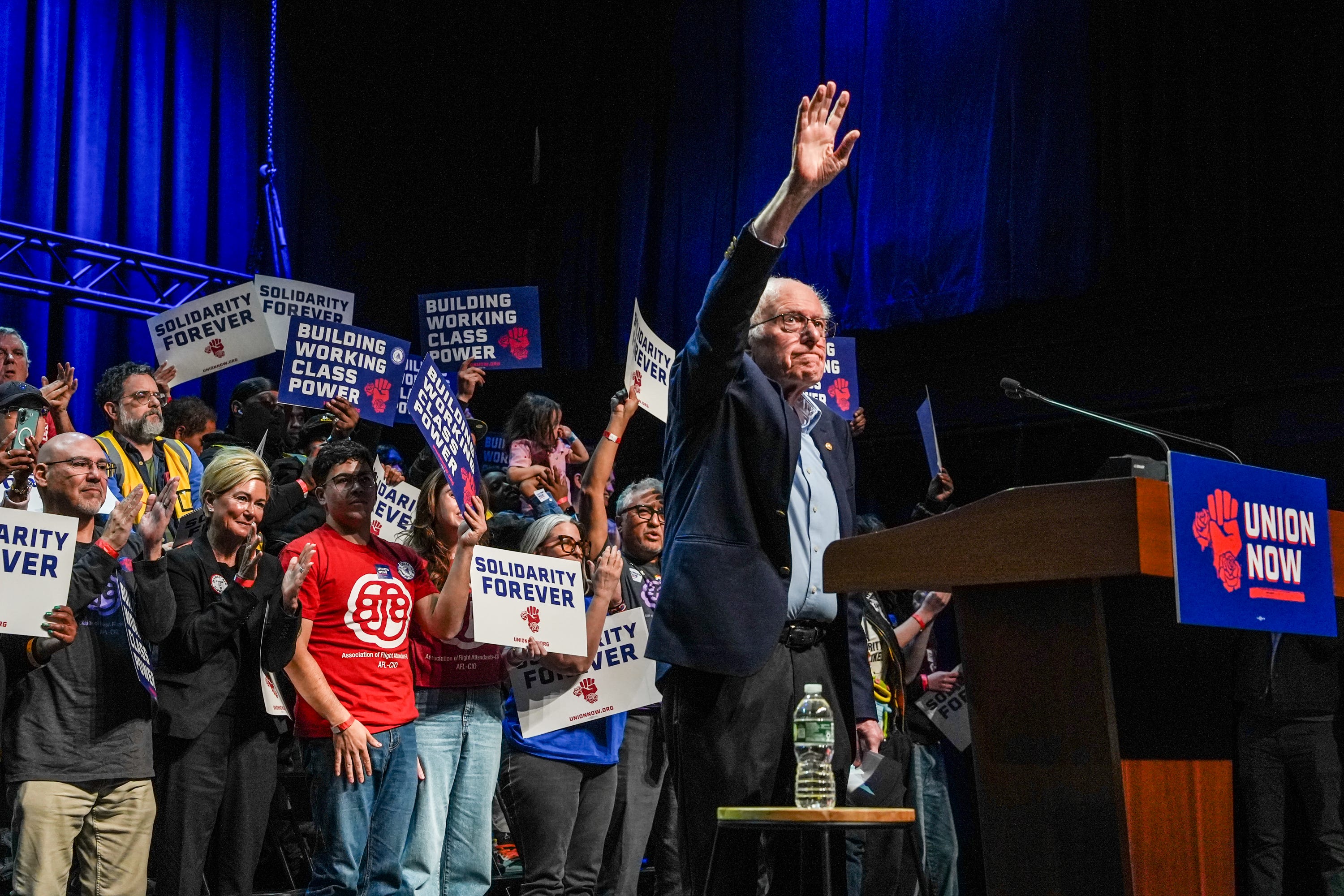
As worker after worker spoke—a video game worker, and a journalist, and a bank teller, and a museum worker—the question came to me: When do you ever see this, in America? When do you see all of these very different types of working people coming together, and sharing their stories, and clapping and cheering and lifting one another up? Nowhere. There is nowhere that a scene like this ever plays out, except at a union rally.
Bernie talked about economic policy, and Zohran talked about city policy, and the union leaders talked about labor policy, and the workers talked about workplace policies. But underneath it all was a deeper ethic. It was the ethic of solidarity: Your fight is mine, and my fight is yours, and we will stand together. We are all family. We will support one another. More simply, it is a vision that rests on love. Love as the guiding force in our interactions with one another. The solidarity, and the organizing, and the political action, and the policy choices are all downstream of the foundation of love. If you decide that you will love humanity then the choices that follow will make themselves.
This is one of two fundamental ethics that give rise to the politics of the world. The other one is fear. If fear is your guiding principle, your dominant emotion, your primary motivating force, then your interactions with mankind will follow a separate but equally understandable path. You will barricade yourself from others, you will guard what you have, you will protect your own people from other people that you perceive not as comrades but as threats. You will build walls and buy guns and hire soldiers and hoard money and close your fist instead of open your arms. You will seek to dominate others as a way to get ahead of them dominating you. If fear is the basis of your vision, then all of these things become common sense, and the things that are motivated by love come to be seen as silly, utopian, unrealistic, openings to be exploited by the more steely-eyed people like you who understand how dangerous this world really is.
Starting from a place of love produces one set of politics, and starting from a place of fear produces another. You can recognize the two sets of policies that arise just by looking at the world today.
It is worth noting that which one of these starting points you choose is not an observation about how the world is—it is a choice about how you want the world to be. To settle on a politics of love is not to deny that the world can be a scary place. It is to decide that the way to make it better is to love one another rather than to kill one another. Solidarity does not arise because nobody is rude, selfish, angry, or annoying. It arises out of the understanding that we are all that way. The fact that people have bad qualities does not have to mean that our entire orientation towards life must be guided by those qualities. It can mean instead that we adopt the opposite qualities, and watch the force of the good unravel the bad.
This is not a modern quandary. Wise people for thousands of years have understood these dynamics. This is the Christian ethic as well, perverted though it has been by mankind. View the world with love, and things like, for example, waging a war in the name of economic domination becomes unthinkable. It violates every principle of solidarity with mankind. It simply cannot be done if you hold solidarity in your heart. But if you accept fear of danger and the subsequent need to do whatever is necessary to protect your chosen people as your starting point, it can be easily justified.
You see a homeless person on the street. Is that person your brother? Then it goes without saying that you need to do what is necessary to help him. You need to figure out how to house him and take care of his needs and give him a path back to a decent life. You need to figure out how to create the infrastructure to accomplish those things. You need to build an agency to do so, and staff it, and tax the public to pay for it. Thus politics are produced from a simple starting point of love. If you start from the opposite point, the politics write themselves as well. That homeless person is a possible threat. He might steal and he is dirty and you don’t want to see him. You have to build a police department and a jail and tax the public to pay the cop to pick the guy up and put him in a cage. Both of these paths follow naturally from their origin.
Politics can be intricate and confusing and riddled with personality clashes and egos and demands to reconcile competing claims of necessity. It is worth, sometimes, taking a breath and remembering why we believe the things we believe, why we feel that it is worth doing the things we do. Center yourself back on your basic guiding belief and the cacaphony of politics will quiet down and the questions will answer themselves.
Do you know the most frustrating things I have ever participated in, the things that made me want to scream at people and cuss them out the most? Unions! Because unions force us to deal with other people as equals, and other people have just as many annoying qualities as I do. But when I feel those frustrations, I can step back and remember that all people are the same and it is necessary for us to love one another and to embrace the principle of solidarity and therefore it is necessary to trudge the sometimes excruciating road to build the unions to win the difficult fights to take care of one another.
Life is not a fairy tale. Having good politics does not mean that life will be easy. It just means that you will be able to look back on your life and know that you tried to make the whole world better and not worse. You will organize the unions and sit in the meetings and pay your taxes and do the socialism because you know that if we all do this then everything will be better for everyone. Because you would rather say, “Hey, I got your back” than “Hey, I got mine, so fuck you.” At union rallies, they often chant, “We believe that we will win.” “We,” in this case, is everyone. We believe in humanity. There is no winning a fight against ourselves.
More
Related reading: We’re All Mice Trying to Chew Through a Trillion Dollar Tree; The God of Solidarity; New York Socialist City; How to Put Money Directly Into Union Power.
C-Span has a video of Sunday’s entire rally, which you can watch here. The rally launched a nonprofit called Union Now to help fund union organizing and strikes, which you can support here. If you’re in New York City, you can support 32BJ SEIU building workers on the eve of their possible strike by coming to a big ass rally tomorrow, Wednesday April 15, at 3 PM at Park Ave and 79th street. Should be fun. We are family.
Thank you for reading How Things Work. This place exists because readers just like you believe that it is worth paying a little bit of money to support it. If you also believe that it is good for this publication to exist, you can help us by clicking that link below to become a paid subscriber. It’s just six bucks a month or $60 for the year, and it keeps us going. Keep coming back.
This is so beautiful that it brought a little tear to my eyes. Thank you for this comrade. Venceremos.
Thank you for this Hamilton. I had read reports about the mayor's speech but next to nothing about this chorus of citizens - you know, the usual "after a few warm-up speakers..." What 'the little people' said IS the real story. We need more of this - and more who will listen and act on what they hear.