
An AI-Funded Sovereign Wealth Fund Is Dangerous
Some constructive thoughts on Bernie's proposal.

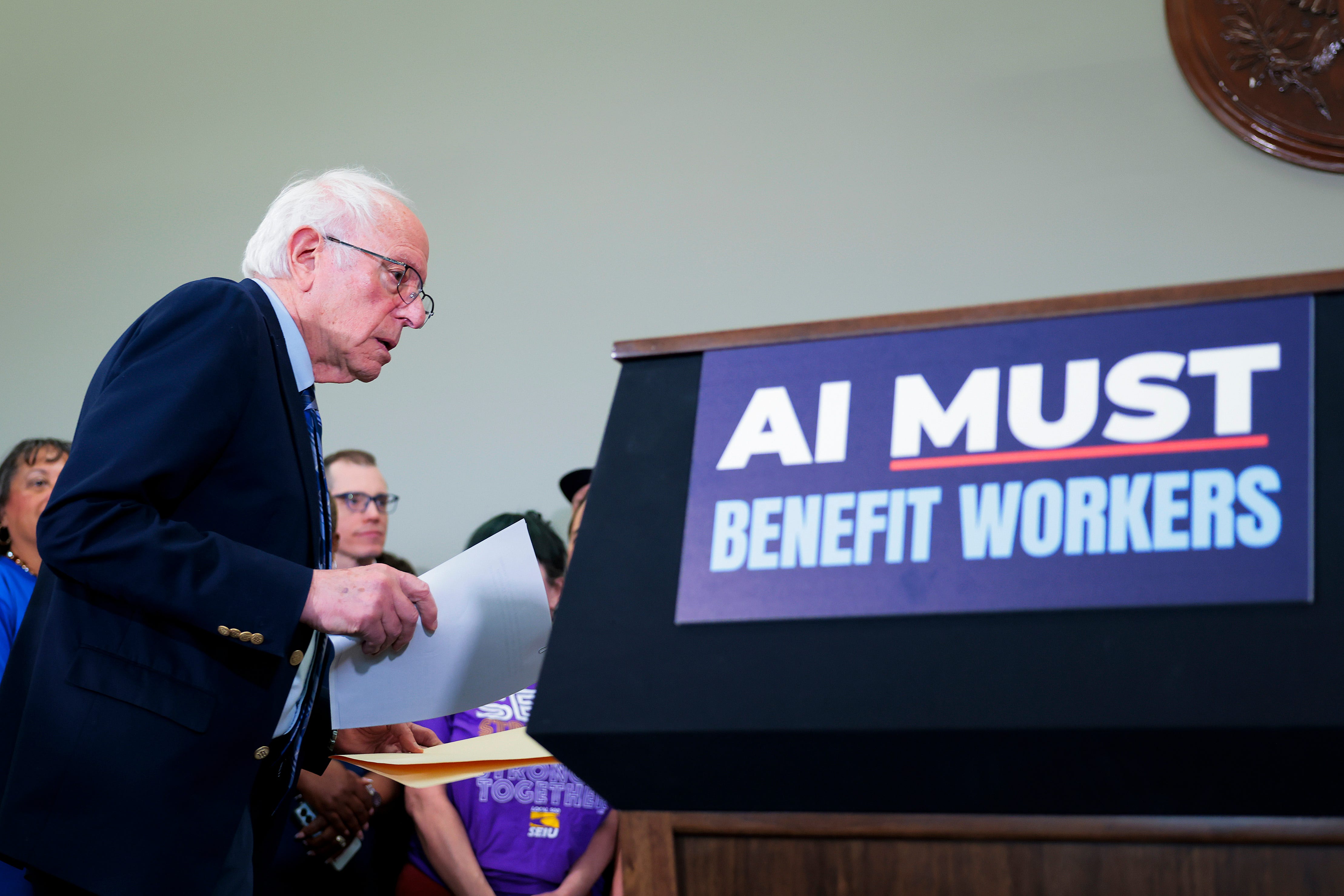
We are all worried about AI. Bernie Sanders has a bold proposal: The federal government will take a 50% equity stake in the big AI companies, and use it to create a sovereign wealth fund that will benefit all Americans. “[This] legislation would guarantee that the trillions of dollars potentially generated by A.I. are used to improve the lives of all of us — not simply to make the richest people in the world even richer,” Sanders wrote. “If the big A.I. companies continue to grow as rapidly as many analysts expect, then the value of the sovereign wealth fund will grow as well — and the benefits to the American people will grow along with it.”
I am just as freaked out about AI as Bernie, and for the same reasons. The actions (or inaction) that the federal government takes in the near future on AI regulation will be of great consequence to the political economy of America and the world. Bernie is trying to set a marker for a left wing, humanistic approach to these issues. The left does in fact need at least some policies to rally around, lest we all holler frantically about how dangerous AI is while the real decisions are made elsewhere.
But I can spot a few potential pitfalls in the approach that Bernie is advocating. In the spirit of advancing the discourse, let me touch on them briefly. First,
We Don’t Need a Sovereign Wealth Fund
The United States of America’s federal government does not need a sovereign wealth fund. We issue our own currency. Money is not a thing that the federal government needs to take from outside of itself and hoard in an investment fund like a retiree. If the federal government wants to spend money, then Congress just votes to do so, and the money is created. We did just that during Covid. Remember? And also to fund all those wars and things. If Congress wants to issue every American a $1,000 per month check, they don’t need to check an investment account that is populated with the stock of major companies and see what the balance is. They just do it. The meaningful constraint on the federal government’s spending is inflation. The meaningful constraint on our economic development in general is “what can humans do in the material world.” Money is just an accounting tool.
The economist Stephanie Kelton—a former economic adviser to Bernie Sanders!—explained it well last year, when she wrote that “Just as the NFL understands that the Superdome doesn’t need a storage facility to accumulate a hoard of points ahead of Sunday’s Super Bowl, and Delta Airlines knows it doesn’t need a strategic reserve of #SkyMiles in order to dole them out at will,” the federal government does not need to seed an investment fund with assets in order to disburse dollars to Americans.
Now, there may be political reasons to pretend that the act of the federal government giving us all money is a thing that is directly funded by a particular investment account. It is the same reason why we all pay into Social Security, rather than just having the government tax us an appropriate amount and then when we get old pay us an appropriate amount: It creates the widespread belief that these payments are justified, that they are a thing that we all deserve, that the federal government has a responsibility to responsibly manage its budget in the same way that you do for your own household. It is a thing that people can intuitively understand and this helps to insulate these programs from political interference. (Notice how easy it has been for right wing ideologues to slash funding for various government programs, and compare that to how hard it would be for them to slash funding for Social Security.) But it is not, strictly speaking, an accurate way to view the way that the federal government funds things.
In this case, the way that people understand what is happening between the government and the AI companies actually matters. Because if we forge ahead with the idea that we’re gonna take a bunch of OpenAI and Anthropic stock and put it into a sovereign wealth fund that will give you payouts, we are creating…
The Investor Mentality
This is extremely dangerous. This, in fact, is capitalism’s most pernicious tool for preventing all of the nice things that The Left says it wants. Virtually all of our collective economic assets—all of the wealth of public pension funds, of labor unions, of college endowments, of hardworking people everywhere trying to save enough to buy a home or retire on—are invested into the stocks and bonds of corporations. Whether you are very conscious of it or not, we are all very much invested in the economic success of all of the corporations whose equity makes up the markets that we are all invested in. Capitalism therefore creates a direct economic incentive in the profitability of these companies, even while the things that all of the companies are doing to be profitable are the things that are fucking us up—crushing labor power, buying off the government, and so forth. (I wrote more about this process here.)
A side effect of Bernie’s proposal is that it would create at national scale the impression that all Americans are investors whose economic well-being is tied to the financial success of the AI companies whose stock is in this sovereign wealth fund. That’s an illusion! The public, as represented by the federal government, does not need to hope that OpenAI stock goes up so that we can get some money. We can just tax OpenAI. Or we can just appropriate money to people. Or, preferably, both. The point is that by setting up the sovereign wealth fund, we would, in one grand gesture, make hundreds of millions of Americans believe that their own incentives are aligned with those of the AI companies, because they are investors in them. In this sense, it would be the greatest and most permanent public relations coup that the AI industry—which is unpopular because it might, you know, destroy humanity—could ever hope for.
Maybe that is why the AI companies themselves as well as Donald Trump are kind of enthusiastic about some version of this plan?
What Problems Are You Trying to Solve?
Bernie correctly points out that AI is a technology that has been built using the raw material of the collective intellectual product of all of humanity. It comes from all of us. To allow the proceeds of the technology to be captured by a lucky few would be a disaster for economic justice. True.
There are other issues with AI as well. If I were to summarize the things that The Left is worried about when it comes to the way that AI’s development is playing out, I would say the main things are:
It’s going to supercharge economic inequality and create a tiny group of unimaginably rich and powerful tech oligarchs;
It’s going to automate and destroy a lot of jobs and crush the power of labor;
It’s going to zap all of our brains and make us unable to think independently, and;
It will maybe, you know, become superintelligent and enslave humanity.
With these basic shared fears in mind, consider the consequences of taking half the stock of the biggest and most powerful existing AI companies and putting it into a sovereign wealth fund. That path would do something to mitigate problem #1—it would reduce by half the potential wealth of the owners of the AI companies. Yeah. Good. Ok. But it does this at a great cost. Because, by promoting in the American public the idea that we all have a direct stake in the economic success of these companies, a sovereign wealth fund encourages everyone to think not as citizens, but as investors. That means that in exchange for addressing part of problem #1, we have created an incentive to give up on problem #2, #3, and #4. Why? Because while normal citizens worry about the damages all of these things will do to people, investors think about and value corporate profits above all. And the corporate profits of AI companies will increase as they become more successful at automating jobs, marginalizing labor, insinuating themselves into the educational and creative spheres of life, and becoming ever more superintelligent. If you don’t believe that being an investor in a company can overpower your abstract political beliefs about the social good of the company’s actions, try being a union pension trustee some time.
The trade that I am describing here is, in sum, an attractive one for the AI companies. Which is why Sam Altman is right there in the middle of the discussions for some version of this plan.
Think instead about what sort of approach we might take in order to try to address all of the problems. That approach would be, in short: Regulate and tax the AI companies. Regulations can put hard guardrails on how companies can use AI to replace jobs, and on how AI can be used in schools and in creative fields, and strict safety and monitoring protocols can be created to try to make sure that these incredibly powerful and wealthy companies do not create the Terminator while they’re fiddling around in search of profits. Then you can tax the fuck out of them to head off the oligarchy and inequality problems. Collective ownership of the equity of companies can certainly be a part of this package, but it is quite dangerous to make it the primary part of the package. We can accomplish the same goals in more socialist ways with less downside. There is much to be written about every aspect of this, but for now it is enough to just highlight the contrast in these two approaches. On one hand, strictly regulate what the AI companies can do in order to prevent harms before they happen, and tax them to balance the scales economically; on the other hand, tell the public that we are all investors in these companies, make people think their own economic well-being is aligned with that of the companies, and create incentives for everyone to overlook the various society-wide problems that the operations of the companies will produce, in the name of maximizing profits.
For these reasons I suggest that we on The Left rethink the sovereign wealth fund thing.
Come to Our Labor Notes After Party

I’ll be at Labor Notes in Chicago later this week. If you see me there come up and say heyyyyyyy. And there’s more good news: This Sunday, June 14, my friends at In These Times magazine are having a great after party and fundraiser that you are required to come to. Get your tickets at this link— cheap! See ya there.
More
Related reading: Capitalism’s Washing Machine; Financing Our Own Destruction; An Existential Threat to Organized Labor’s Ability to Help People.
I wrote a book about organized labor and why it is the key, the heart, the most vital ingredient to heading off the socioeconomic apocalypse that looms for America. It is called The Hammer and you can order it from an independent bookstore, or wherever books are sold. Still feels relevant! If you want me to come speak to your group about these issues, email me.
Thank you for reading How Things Work. There is no AI writing in this publication. Nor will there ever be! I will just drink poison before then. If you would like to do something to help support humanity over robots in the field of media, I encourage you to become a paid subscriber to How Things Work (or, gift a paid subscription to a friend). It’s not too expensive. It allows this place to exist, and stay paywall-free so that everyone can read it. And it helps independent media keep going, which I think is legitimately important these days. I appreciate you all for being here.
The greedy rich have spent a trillion or two over the past 50 years to convince us that MMT is not true. They had too because it is true by definition. A financially sovereign government creates its own money.
Also, LLM AI is being force fed to us by greedy rich advertising. LLM AI will never be profitable in the standard business sense. Bernie and many others have been bamboozled and that can't end well if it persists.
And the sovereign-wealth-fund idea never addresses the other major problem with "AI" - the ecological damage caused by data centers' relentless demands for fresh water and energy.
Regardless of whether "AI" attains any trustable level of accuracy in its results; regardless of what profits are generated and by whom they're received: ETHICAL USE OF "AI" IS NOT POSSIBLE until and unless its environmental impact is mitigated.