
An Existential Threat to Organized Labor's Ability to Help People
We are not afraid enough of AI's pernicious dynamic.

Rarely has a story filled me with such a profound sense of dread as Josh Dzieza’s New York Magazine piece this week headlined “The Laid-Off Scientists and Lawyers Training AI to Steal Their Careers.” More than anything I have read before, this story has begun to crystallize for me the exact ways that AI is a threat not just to jobs, but to the entire existence of organized labor in America. This is serious shit.
We are all familiar with the ways that the “gig economy” has preyed upon flaws in American labor law to weaken workers and strengthen capital. Employers figured out that by making all of their workers “independent contractors,” they could avoid paying them benefits, abdicate most responsibility for their welfare, push work costs onto them, and, crucially, rob them of the ability to legally unionize. This dynamic has been evident across the economy for decades. The same dynamic making people become Uber drivers also has made everyone adjunct professors and has made everyone work for shoddy subcontractors rather than directly for the firm that it seems you actually work for. It is the push to eradicate, to the extent possible, the existence of the full time employee. The rise of the gig economy is a serious threat to organized labor power. The labor movement has made efforts to nibble at its edges, but success has been hard to come by.
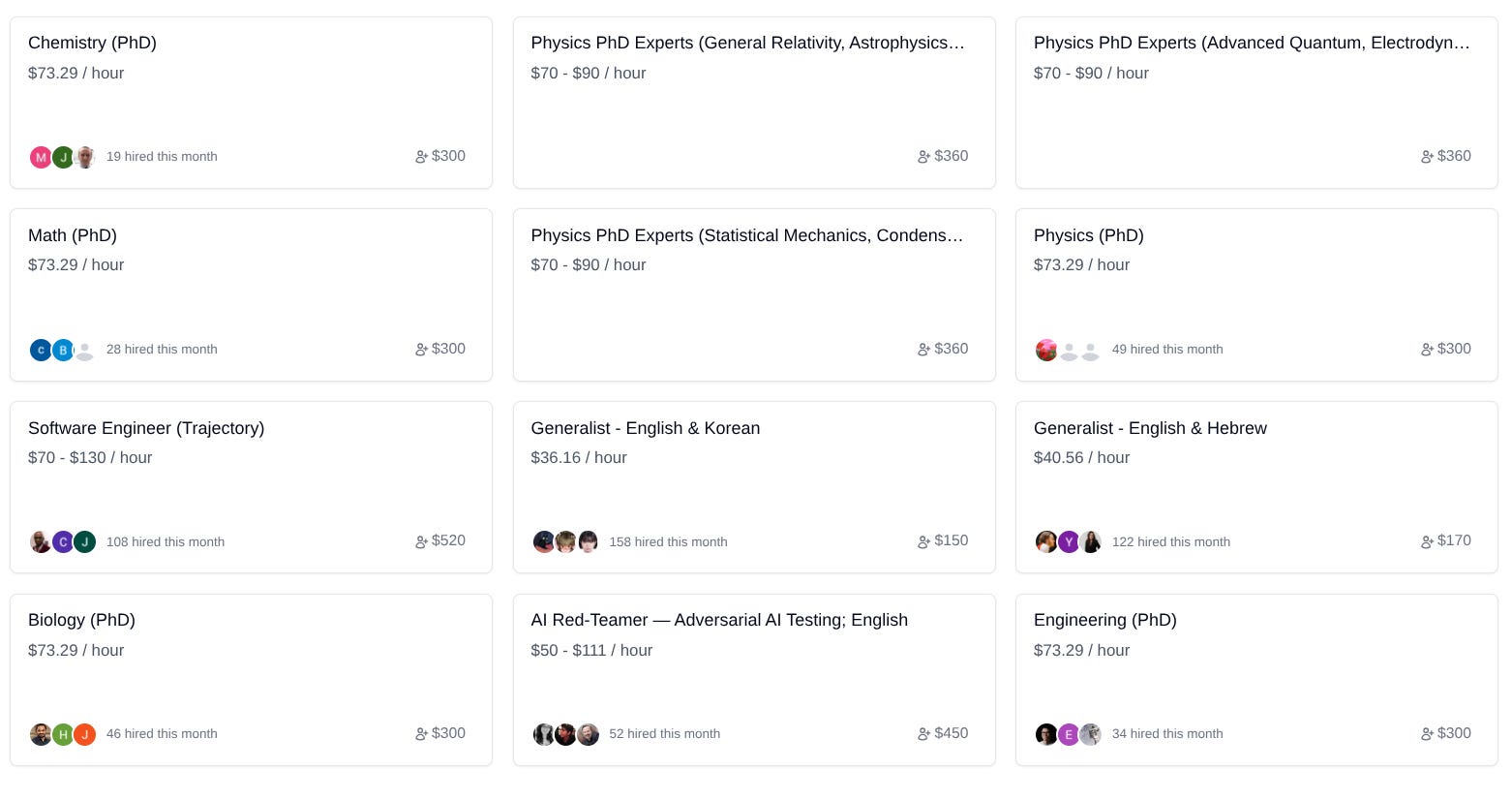
In Dzieza’s story, I saw something that is potentially even more deadly. He profiles Mercor, one of several companies in the business of hiring economically desperate professionals—not just lawyers and scientists, but screenwriters, designers, PhD’s, and experts in a wide variety of academic and professional fields—to train AI models to become better in their areas of expertise. Major AI firms hire Mercor to improve their models. Mercor recruits the appropriate pool of expert workers, all as contractors, all working remotely, and then, with no predictable schedule, tosses them batches of work, which they all compete to finish as quickly as possible. Workers do not know the end client. Workers are monitored by software that tracks their actions scrupulously the entire time. Workers can be deactivated and cut off from their supply of work for any reason at all. Workers describe a process of the company cutting rates for the same tasks over time—from $30 an hour, for example, down to $16 an hour. Mercor’s 22 year-old founders became billionaires last year.
Exploitative work is not new. It is a feature of capitalism. American workers have been fighting against it for centuries. The labor movement has a rich history of organizing highly exploited workers and improving their conditions. Coal miners. Factory workers. The list goes on. People died. Violence was intense. Is a company like Mercor really so bad compared to all this?
The answer, I think, is that a company like Mercor poses a fairly unique challenge to the labor movement’s prescription for empowering workers. Here are some characteristics of the type of work that Mercor and its AI industry clients are offering. While many of these characteristics have been present in various workplaces throughout modern history, I do not believe that this lethal combination of characteristics has ever been so ascendant at the center of our economy:
No worksite. Remote workers are hard to organize.
No full time employees. Independent contractors cannot legally unionize.
Workers are in competition with one another for piecework, rather than cooperating on tasks. The nature of the job encourages workers to see one another as threats, not as peers with whom to foster solidarity.
Total technological control of the work process by the company. Absolute monitoring of tasks, absolute lack of transparency by workers into the company’s operations and what their coworkers are doing, and absolute ability of the company to fire workers at will.
The success of the company contributes to the economic precarity of its own workforce. These workers, already unable to find jobs that can support them after years of training, are employed to improve the AI models that will automate their own industries. The better Mercor’s workers do their work there, the fewer good jobs for humans there will be in their own fields.
The workforce gets better as it becomes more economically desperate. A subtle second-order effect of the dynamic described above is that as improved AI models eat more jobs in professional fields, the pool of highly trained workers forced to work for a company like Mercor will expand. Meaning that over time Mercor will be able to offer AI companies more highly skilled workers to train its models, while at the same time being able to offer those workers less, because they are competing with more of their unemployed peers. The leverage of the workers goes down as Mercor’s ability to hire better workers goes up.
As you consider this set of characteristics, ask yourself: Where, exactly, is the realistic intervention point for a labor union to build power for workers here? Even if you were able to overcome the significant hurdles of having a disparate pool of remote workers, and make a list of workers to organize, and pull them together and get them willing to act in solidarity, and avoid having the company deactivate them immediately, they are still caught in a system that is constantly employing them to undermine their own leverage. Even in the best scenario, labor’s leverage at a company like Mercor would be: The company can’t fire these workers because there is a demand for their services from the AI clients. But the more successful the workers are at their jobs, the more the advancing AI models will automate their industries and create an expanding pool of desperate workers who are forced to underbid and undermine the workers at Mercor who organized. It is a non-virtuous cycle. It is a bloodless white collar version of an imperial conqueror who employs impoverished natives as soldiers to oppress their own neighbors.
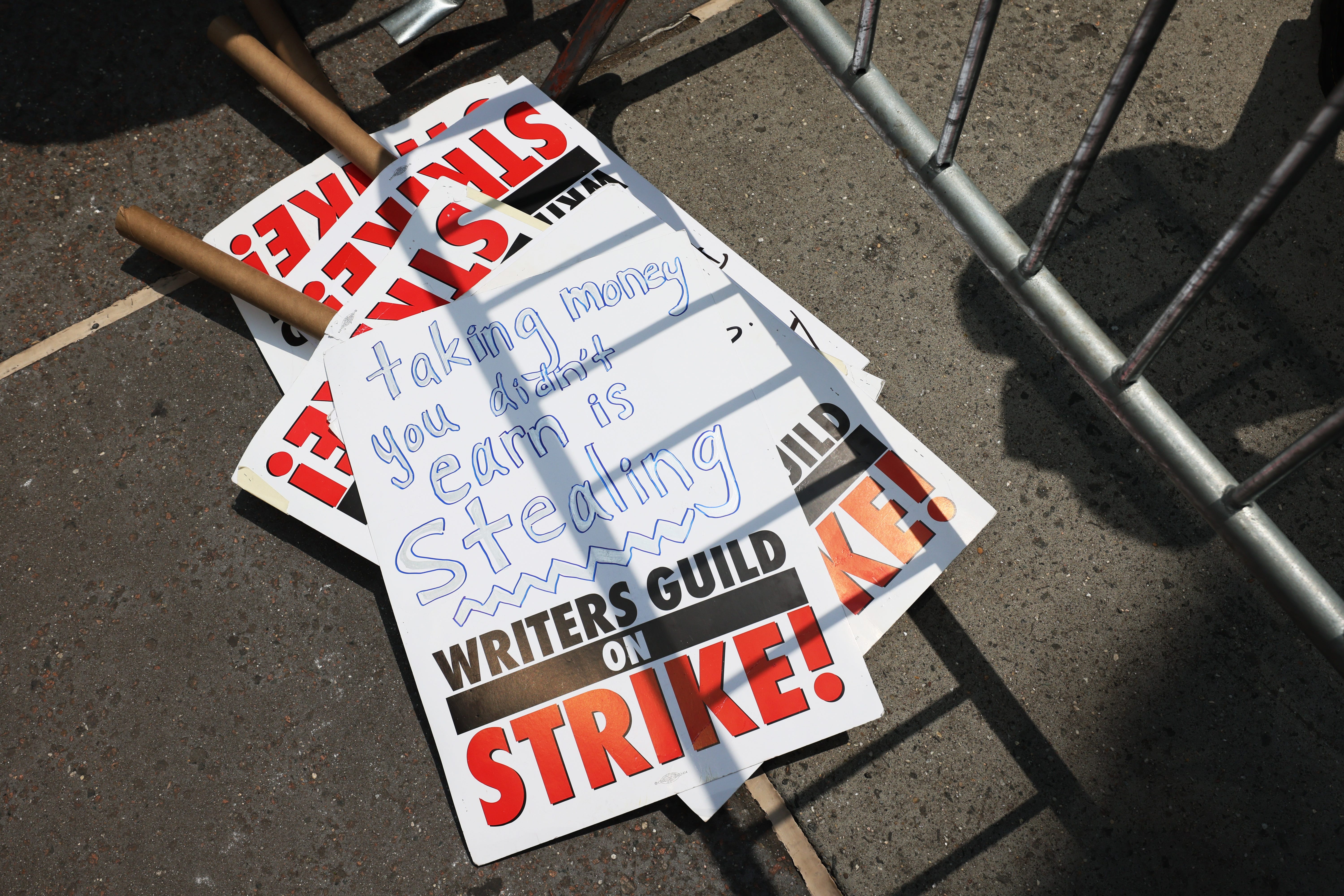
My own union, the Writers Guild of America, has more or less fully unionized the screenwriting industry. The union is strong and well organized and has experience using its position at a vital chokepoint in the entertainment industry to build and exercise power for writers. It is probably the best-case scenario for existing unions facing this type of AI threat. And even in the case of the mighty WGAE, what companies like Mercor are doing give me the sickening feeling that we are fucked.
The WGA signs contracts with all of the big Hollywood studios and entertainment companies that make films and TV shows. We have an ability to exercise power against these existing companies. We can put provisions strictly regulating AI in our contract with these firms, and strike to enforce it. The real threat we face, though, is not just from the firms who are signatories to our contract wanting to use more AI to replace writers. It is that AI models, trained by us, will become so skilled at replacing writers that entirely new firms can rise up, with little friction, and make film and television without employing writers at all. AI is not the usual sort of threat to labor. In the case of AI, economically desperate workers of today are not training their temporary replacement, or helping a company move to a different place where labor is cheaper; they are training a permanent replacement. The highly trained workers at Mercor are in effect the last gasp of the skilled workforce that they thought they would be entering. They are the desperate members of an expedition, forced to eat the horses that were their only hope of escaping the bad place they are in. After that, they can only eat each other. Then they all die.
Even with respect to “the gig economy”—though it is very difficult—the path for organized labor has been clear. Organize the workers. Build their collective power. Use that power to fight and win protections. But this entire paradigm is being broken now. Even if we could organize the workers of Mercor (something that unions have thus far not even attempted in any serious way), we cannot escape the fact that the very nature of their work is to improve the thing that will destroy their own career prospects in the future. We do not have unions at the AI companies. We cannot strike against them in any meaningful way. Nor do we have a clear path to assert the power of today’s highly skilled workers against the companies of the near future that will be using the AI models we just trained to replicate our work without us.
The progress of the AI industry is in effect shrinking the sphere of economic life in which unions might even hope to be able to help humans. At some point that sphere will become too small to matter to most humans.
This is not just about writers. Not even close. It is about architects and lawyers and scientists and teachers and a whole host of other fields that are facing the same dynamic. The basic threat of white collar job automation by AI has been understood for a long time. But I do not think that organized labor itself—all of the labor unions in America today, the ones still able to exercise power on their own little industrial islands—has really begun to reckon with what we are up against. It is not just that workers are threatened by the job automation, the disappearance of their careers, their declining leverage in the economy. It is that, absent federal laws, it is unclear what unions can even do about this. We can’t organize AI models, and organizing unemployed people offers little power.
The speed at which the AI industry is moving relative to the federal government means it is pretty unrealistic to expect any of us to be saved by the law any time soon. This is very bad—even for the lucky slice of workers who are members of strong unions today. A guillotine is being constructed, by our own desperate peers, that will be capable of rendering today’s version of organized labor more or less obsolete, at least in many of today’s industries that host strong unions. We are heading to a place where not only are workers exploited, but organized labor as it is currently constituted has no moves to make to help them. I confess I don’t have the answer here. But we had better get our fucking thinking caps on, fast.
More
Related reading: Minimum Standards for Taking AI Seriously; Thinking of AI as a Social Problem; The Gig Economy Is a Vampire; Ten Times This.
Despite my pessimism here, it remains true that increasing union density is the most direct way to build the army necessary to take on the forces of capital that are pushing the transition that I talk about in this post. Unionize your workplace, now! Wherever you work! The labor movement needs all the soldiers it can get. I wrote a book about this, which you can order from any independent bookstore.
This publication exists because readers just like you choose to become paid subscribers. There will never be a word written by AI here, unless I am dead. If you enjoy reading How Things Work and want to help us keep existing in 2026, take a quick second right now and become a paid subscriber. It’s affordable and it makes you cool. Thank you all for reading.
It may be that technology is finally dissolving the relationship of mutual necessity between capital and labor that allows labor to act *as labor*, but that was always something we’d have to move beyond if we were ever to free ourselves from capital. This reminds me of Joshua Clover’s book “Riot, Strike, Riot”, and the possibility of moving the sites of resistance and changing our conception of who we are in opposition to our oppressors. It can indeed be very powerful to organize unemployed people - it’s just not “labor” power.
A note about the power of organizing unemployed people: a couple of unions have used their resources to start workers co-ops (https://youtu.be/24LKA_8rk2k, around the 19 minute mark). That’s helping to organize un- and under-employed people into workers co-ops, and it’s a way to increase worker participation in the labour movement, create more democratized workplaces, and provide services for communities.
In addition, in Canada, things like the On-to-Ottawa Trek in 1935 (https://www.thecanadianencyclopedia.ca/en/article/on-to-ottawa-trek) and the National Unemployed Workers Association in the 30s (https://www.esask.uregina.ca/entry/workers_unity_league.html) showed the power of organizing unemployed people. As Bill Waiser writes about the NUWA’s perspective in All Hell Can’t Stop Us, “Joblessness was not the consequence of personal failing, but the collapse of the capitalist system…. ‘Organize unemployed councils…Fight, don’t starve.’” We once again need to get away from the idea that, unless you’re able to get a union card, you’re not part of the labour movement; it weakens solidarity across the working class.