
Minneapolis Is The Way
Why fascists hate the labor movement.

I just got back from Labor Notes. It’s the biggest conference of the grassroots, activist wing of the labor movement. Thousands of union members who are fired up to make the world a better place. It’s a thing that will make you feel hopeful.
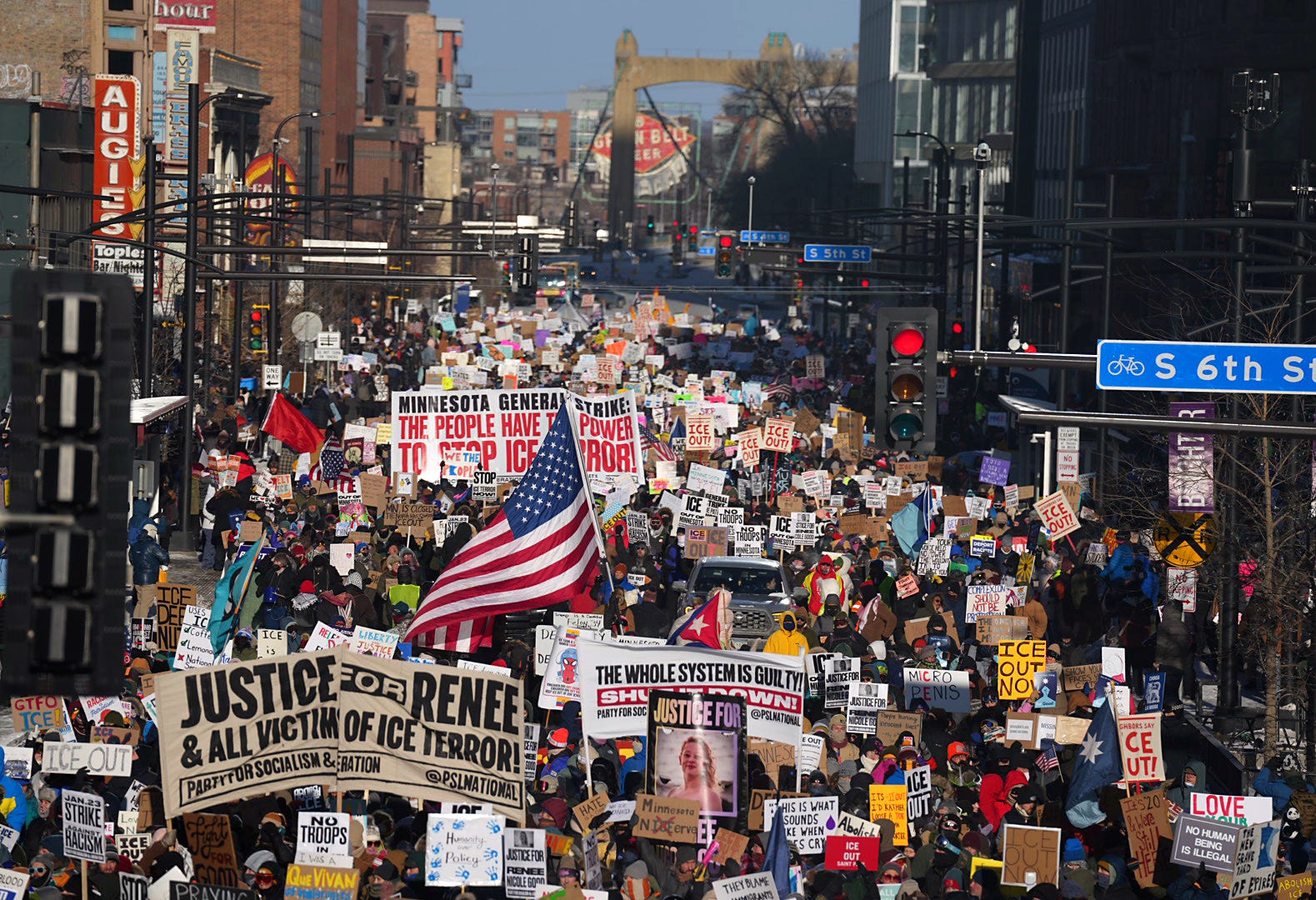
There are hundreds of panel discussions and workshops at Labor Notes, and no one can go to more than a small fraction of them. But I want to discuss one of them, which focused on what is, to my mind, the most important union action of the past year: the long and ultimately successful struggle by the people of Minneapolis and St. Paul against ICE’s militaristic occupation of their cities.
I got to moderate a panel that included both elected union leaders and rank and file members from the Twin Cities, who talked about the nuts and bolts experience of the ICE surge, the rapid resistance to it, the enormous citywide march against ICE on January 23, and the aftermath. It was fascinating and inspiring and it helped to show us all not just what unions are, but what they can be.
These were unions representing teachers and hotel workers, service workers and janitors and telecom technicians. Regular working people. They spoke about the brutality of ICE’s operations, and how they sprung into action. The teachers made plans to protect their students and schools. The unions all plunged themselves into mutual aid and protection for their immigrant members. And, after an initial phase of figuring out how to safeguard their own people, they threw themselves into a staggering citywide effort to resist ICE in every way possible.
The Minneapolis area has one of the most impressive citywide labor movements in America. It has a rich history of strikes. The leaders of the city’s unions today have had the benefit of going through both the George Floyd protests of 2020, and of planning and executing a multi-union, multi-industry coordinated citywide contract fight in 2024. They have practice working together—like a real movement, rather than an atomized collection of interest groups. When ICE came to town, they were able to exercise those muscles immediately. When they decided, with only a couple of weeks’ notice, to have a huge march and shut down the city on January 23, they were able to pull it off. And the city’s unions were able to bolster the larger projects of mutual aid and immigrant protection and protest and resistance that pulled in everyone, not just organized labor. One union leader described speaking to leaders churches and community groups and saying: You figure out how to build the most power in your thing, and we’ll figure out how to build the most power in our thing, and we’ll all do it on this timeline. Decentralization with a common cause. It works.
Resistance is not free of consequences. Minnesotans who were watching ICE were killed. Thousands more were arrested and assaulted by federal troopers, and some 1,700 were deported. The economic loss to the city as a result of ICE’s operations has been estimated to be $700 million. The human cost is incalculable.
Yesterday, the Trump Justice Department announced that it has indicted 15 anti-ICE protesters from Minnesota, branding them “Antifa.” Workday Magazine reports that some of those indicted are trade unionists whose presence at worker assemblies organized by local unions is included as evidence of their criminal activities. Kieran Knutson, the president of a Communication Workers of America local in the Twin Cities (and who spoke passionately on the panel at Labor Notes) told Workday that the worker assemblies were organized as a way to allow members of different unions across the area to come together “across different unions, across different industries, across different trades, in a way that’s directly democratic, to talk about and discuss and debate issues.” In other words, the basic stuff of movement building is being met with criminal charges.
You can read the indictment here. It is Orwellian. Hinging as it does on the vague rubric of “Antifa” and the equally vague crime of “conspiracy,” it charges these protesters with actions like “Utilizing social media, text messaging, encrypted messaging applications, and word of mouth to advertise and promote specific direct actions.” Among the “overt actions” listed as evidence are attending civil disobedience trainings, starting Signal chats to coordinate protests, writing an article for an “anarchist blog,” blocking a road leading to ICE’s headquarters, and raising money for protests and mutual aid. At every step, the indictment makes it a point to note if anyone was wearing an “Antifa” sweatshirt, or had some antifa patches in their home.
We are all antifa now. We have been since last September, when the White House’s memorandum titled “Countering Domestic Terrorism and Organized Political Violence” instructed federal law enforcement agencies to investigate and prosecute those practicing “anti-fascism,” which is described like so: “Common threads animating this violent conduct include anti-Americanism, anti-capitalism, and anti-Christianity; support for the overthrow of the United States Government; extremism on migration, race, and gender; and hostility towards those who hold traditional American views on family, religion, and morality.”
Buddy, that’s everybody I know! Like many things that happen under fascist governments, this sounds like a bad joke and you laugh at it right up until the police break down your door. The people just indicted in Minnesota are all of us, exercising the same rights as the rest of us, in defense of beliefs we all hold. They are the unfortunate ones swept up and punished as examples to all of the rest of us. The persecution of the few is intended to instill fear in millions more.
Anti-fascism, a philosophy that should be considered a minimum standard of human decency, will be a long and hard fight. It will require not just actions, but institutions. The unions of the Twin Cities—and the churches, and the community groups—are examples of what those institutions can be. They were building strength in the community before the fascists showed up. They can tap into that strength to oppose the fascists. And they will still be there when the fascists finally pack up and leave. It is a good thing to go to protests, but it is more meaningful to unionize your workplace. Actions come and go, but institutions last. They are durable. They have a transformative power: you are not just a hotel room cleaner or a janitor at Target or a cable installer at AT&T or a middle school teacher—you are a member of a union and a part of a labor movement that is strong and united and can wield political power that you alone cannot.
I was in Minneapolis the day that Alex Pretti was killed. Standing out on a tear gas-choked frozen street that resembled a war zone, I had the distinct thought, “This is coming for everyone.” Minneapolis is not unique. It is a preview. The labor movement of Minneapolis is not something to be admired from afar; it is a road map for the rest of us. Get yourself a movement, before the fascists come knocking on your door.
More
Related reading: Dispatches from Minneapolis on the day before the January 23 strike, the day of, and the day when Alex Pretti was killed. Also, in September, Haymarket Books will publish a pamphlet about the lessons of Minneapolis titled “This Is How We Win,” which I contributed to along with many others. You can preorder copies here.
For the good of the labor movement, please be sure that you are subscribing to both Labor Notes and In These Times magazine. I wrote a book about the labor movement called “The Hammer,” and if you want to order it from an independent book store, you might like it. You can read these things while wearing a fly “How Things Work” t-shirt.
Independent Media: another institution that we need. I hate to be a broken record over here, but it is a fact. You may notice that the publication you are reading right now, How Things Work, does not have a paywall. Anyone can read it whether they can pay or not. The only way I am able to do that and still make a living is that I say to all of you: If you like reading this site and you can afford to contribute a bit to its existence, please become a paid subscriber today. As long as those can afford to pay do their part and toss in, the whole system can work. Socialism in action. Thank you all for being here.
Sure needed this uplift. Thanks!
Keep writing, keep watching the scum where they are, as most of us have to trust "the news", which is often made of mush. Thank you.