
Corporate Power Approaches Escape Velocity
A failed Tesla strike in Sweden is a flashing warning light.

If corporations become more powerful than national governments, we are all in trouble. The reason for this is straightforward: Corporations are not real objects. They do not exist in nature. They are legal fictions created according to a set of laws that dictate what they can and cannot do. Those laws, which quite literally create corporations, are made by governments. The rights of corporations and the limits of their operations are entirely dictated by governments, which write the laws and administer the courts that both enable corporations to exist and make money, and put boundaries on them. If governments lose their ability to draw hard lines on the behavior of corporations—if corporations become so powerful that governments are no longer able to tell them what to do—then corporations become the supreme power on earth.
This is bad, obviously, but it is worth stating why it is bad. It is bad because governments, while imperfect and sometimes even malignant in many ways, ultimately derive their legitimacy from the will of the governed. Legitimate governments, good governments, democratic governments are obligated by some scrutable process to work for the public good, as they define it. We all know the many ways that this can go awry, but when governments are bad, we can tell that they are bad because they fail on their most basic task of empowering themselves with the will of the public to increase the public good.
That’s not what corporations do at all. Corporations care not for the public good, nor for the public’s very existence. Corporations are robots, algorithms—AI programs, if you like—that work for the lone goal of increasing profits. Their definition is the same as that of cancer. They grow without regard to the good of the larger body. A perfect corporation would enslave the entire world in order to enrich the last free people on earth, its own shareholders. (Indeed, various companies in history have tried their best to carry this out in portions of the world.) You can’t get mad at them for this any more than you can get mad at a bullet for killing you. This is their nature. This is their purpose. This is what they do. If you don’t want them to do this, you must place limits upon them. That is a big part of why governments exist.
This is rudimentary stuff, but I articulate it because unless we always keep it in our conscious minds, there is a risk that it can be stolen away. Corporations always and everywhere have a natural incentive to neutralize their master, the government. They do this by lobbying and buying politicians and running astroturf PR campaigns to shape public opinion and doing all of the other legal things that allow them to accrue formal political power, but all of that should be recognized as a half measure that they only tolerate while necessary. Corporations never seek to abolish or destroy the government—they need the government administering laws in order for them to exist. Instead they seek to completely subjugate the government to their own will. Their ideal state would be to write and administer the laws that govern their own behavior, to arrange society in such a way to maximally benefit them. Obviously! That’s what robots do. This has always been true and will always be true as long as private corporations are the primary way that global production is organized. Knowing that this is the case, government must always ensure that it is able to hobble corporate ambition before it begins to threaten society as a whole.
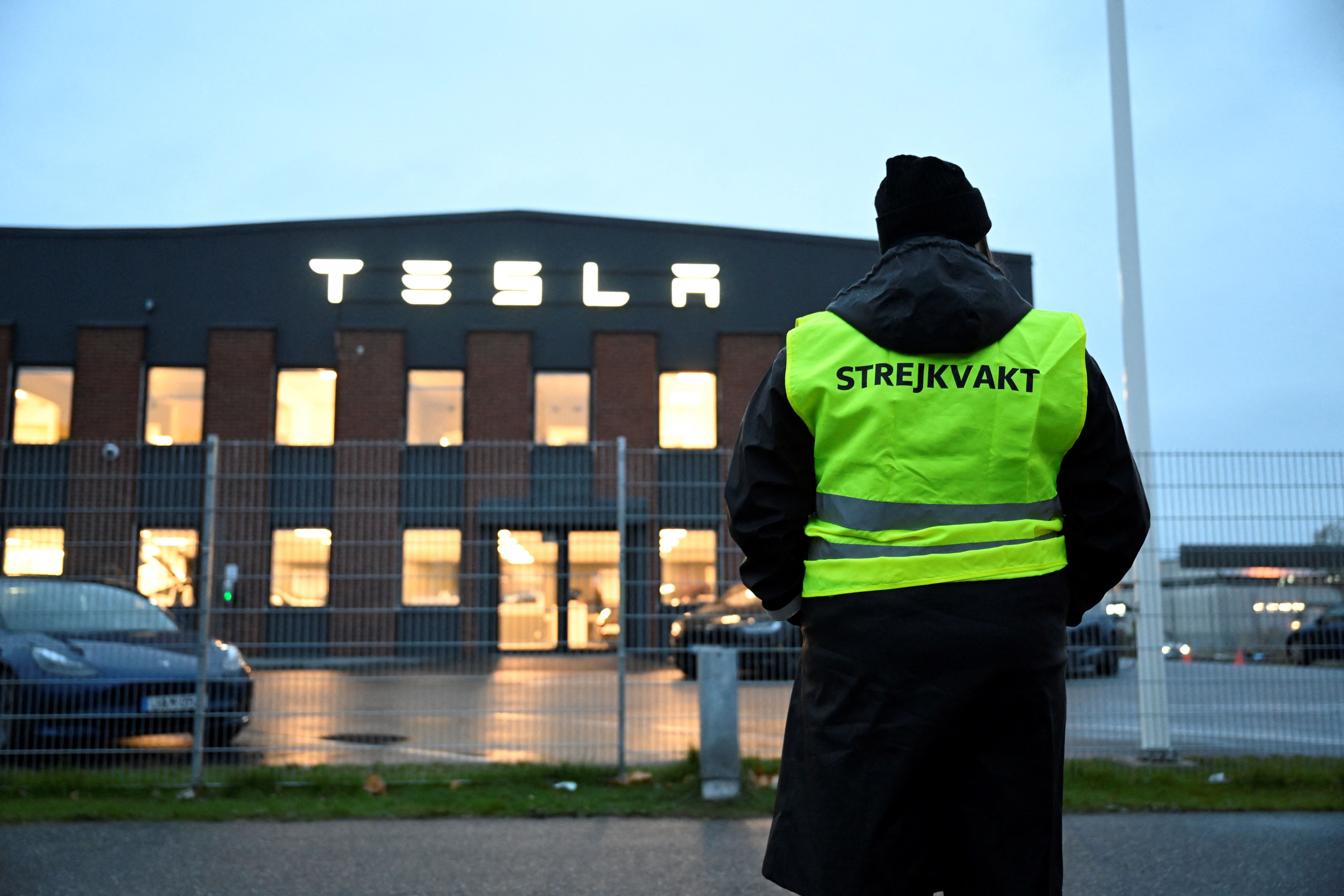
A three-year-long strike against Tesla in Sweden just ended. The strike was an attempt by organized labor in Sweden to get Elon Musk to acquiesce to the simple demand of collective bargaining with his employees. Setting wages and working conditions via collective bargaining, along with profit sharing and collective investment, are at the very heart of the Swedish postwar economic model that made the small nation into a haven of high living standards. The expectation that a company like Tesla would allow its workers to choose to collectively bargain a fair contract is much higher in Sweden than it would be in America. When multinational corporations go into, say, China to do business, and the governments demands that they, say, censor search engine results for “Tienanmen Square massacre,” the response from those corporations is generally to obey and then to turn around and shrug and tell their critics that they are obligated to follow the laws and customs of the nations in which they operate. But when it comes to something that might restrict their profits—allowing their workers to unionize—that attitude changes.
The strike in Sweden ran for three years, and pulled in support from organized labor throughout the country. It is done now, and it failed, because for all of those years, and despite the fact that collective bargaining is expected to be a central pillar of being a good corporate citizen in Sweden, Elon Musk (despite being the world’s richest man) simply refused. Tesla succeeded in buying out all of the striking workers until there was no one left to be on strike. This is sort of like buying a restaurant and closing it down rather than giving your waiter a tip. It is an abrasive and offensive act designed to prove a point about where the power lies in this relationship.
The statements put out by Swedish labor organizations about the end of this strike are worth quoting at length. I’ve put some relevant sentences in bold. First, from IF Metall, the labor union in question:
IF Metall has decided to end all industrial action against Tesla’s Swedish operations.
The reason is straightforward. Tesla has bought out all of our striking members at the company. With no members remaining at Tesla, our industrial action can no longer have an effect.
This does not mean that the fundamental issue behind the conflict has changed. Our goal remains that collective agreements should apply throughout the Swedish labour market, and IF Metall remains ready to fight for collective agreements wherever and whenever employers oppose them.
Tesla, however, has proven to be an entirely exceptional employer. Rather than accept collective bargaining, the company has systematically used strikebreakers and devoted enormous financial resources to undermine the strike. Ultimately, Tesla chose to buy out our union members rather than give them the security and influence that comes with a collective agreement.
And second, from LO, a Swedish national labor federation (in English via Google Translate):
– IF Metall encountered a company led by the world’s richest man, also a person who has a grudge against unions and the way we do things in Sweden. Tesla has gigantic financial resources and has used them, among other things, to buy out the strikers. It is unique.
– Without strikers, there is no strike. The fact that there is no collective agreement in place is a failure, but it is the union’s mission to take on such battles. We have no regrets, the union movement must dare to take on such battles, even if there is a risk of not reaching the end.
– Tesla has used methods to stop the strike that we have not seen in Sweden in almost 100 years. Strikebreakers have been flown in and a cat and mouse game has been played with notices against the postal service. This caliber of buyout of strikers is also unique, and costly for the company.
Everyone who believes in democratic government and in human rights needs to have a radar that starts flashing when something like this happens. This strike is alarming in a way that the failure of a normal strike is not. This strike was popular, well-resourced, and supported in principle by the government and by the larger Swedish labor movement in ways that would be impossible in America. Tesla, a $1.3 trillion company whose stock price has risen by two thirds in the past year, could easily afford these workers’ demands. Elon Musk, whose net worth has increased by hundreds of billions of dollars during the time of this strike, would not have been affected one bit. Yet Tesla and Musk decided to buck public opinion and give the cold shoulder to all of Sweden and appear rude, obstinate, and greedy, in order to ensure that this small number of employees did not win a union. And Tesla succeeded.
Yes, corporations are greedy and they always fight unions, but this is more than that. Global companies that are ruthlessly anti-union in America, where that is expected, often acquiesce to unions in nations where union busting is not so easy. Walmart now has a union in Canada. Amazon has had unions in Canada, Europe, and India for years. The existence of those unions is a data point indicating that societal expectations and labor-friendly laws and regulations and politicians can, when added to the power of organized labor itself, be a decisive weight against corporate power. The Tesla strike in Sweden is the sort of thing that, in the end, the company should have accepted. Yet it didn’t happen that way. Tesla, in a sense, has proven itself not just stronger than the union, and not just stronger than the Swedish labor movement, but stronger than the nation of Sweden itself. I am not paying Tesla a compliment here, nor am I saying anything bad about Sweden or its labor movement. I’m just trying to say that a warning light is blinking about the balance of power between governments and corporations on a global scale.
Perhaps the union will make another run at Tesla in Sweden. Perhaps Tesla’s actions will make it so unpopular that its Swedish business will crater. Perhaps Elon Musk will overdose on ketamine, or be struck blind by an angry god, or go broke when he loses the AI race. I don’t know. What I know is that the fact that this strike was lost, at the same time that ungodly sums of capital are flowing into an almost totally unregulated and severely concentrated set of tech and AI companies, should make us all very uneasy. Corporations are always going to fight for their own interests. How able our we and our governments to prevent them from rearranging our entire societies and national economies to their own benefit? How do you reckon the combined power of Apple, Google, Tesla, Space X, Anthropic, OpenAI, Microsoft, Nvidia, Amazon, and Meta compare, today, to the total power of the United States government? How able are we, collectively, to tell these companies “no,” if we want to?
Something to think about.
Also
Related reading: State Power Versus Capital Power; Companies Stronger Than Governments; Technology Does Not Solve Political Problems; Corporations Do Not Have Any Rights That We Don’t Give Them.
Contact an organizer for help unionizing your workplace. Join DSA. For a longer discussion of organized labor power as democracy’s salvation, check out my book “The Hammer.”
NOT A SINGLE FUCKING BILLIONAIRE GIVES MONEY TO HOW THINGS WORK. You can’t say that about Axios, I bet. Support humanity. Support independent media. Become a paid subscriber to help keep human writing alive. Cheap!
This situation is the background in the 1950s science fiction novel, The Stars my Destination by Alfred Bester. It is one of my favorited sf novels, you should give it a read.
Honestly, fuck Musk and all his fellow oligarchs. They cannot escape the fact forever that they mere cogs in bigger systems.