
Can Fascists Still Be Shamed?
A conversation with Chris Mathias, author of "To Catch a Fascist"

Christopher Mathias is a veteran journalist who has spent years covering America’s far right. His new book “To Catch a Fascist,” which hits stores today, is an in-depth look at the real world activities of the antifa activists who unmasked many of the most notorious neo-Nazis and white nationalists of the past decade. The book is a vital corrective to the “antifa” boogieman created by right wing politicians—and a foreboding exploration of the fascist cultural roots that have now grown, triumphantly, into Trumpism.
I spoke to Chris about American fascism, the uncertain power of shame, and the creeping reclassification of dissent as “domestic terrorism.” Our conversation is below.
How Things Work: It feels like many people still can’t agree what “fascism” means. You have a useful definition of fascism in your book. What is it?
Christopher Mathias: So there are a lot of academic definitions out there which I found really helpful, but my kind of working definition, and the one I use in the book, goes something like this: I see fascism as a right-wing politics of domination, often taking the form of ultranationalism, that situates a particular subgroup of people atop a social hierarchy and targets already marginalized groups for expulsion or death, all in an effort to “cleanse” or “purify” the nation, restoring it to a mythical (nonexistent) past of ethnic or cultural homogeneity.
Researching this book, though, changed my whole way of thinking about fascism. I think so much punditry over the last ten years has been fixated on what we are experiencing as precisely analogous in this or that way to Hitler’s Germany or Mussolini’s Italy—that only after key thresholds are crossed can we actually say it’s happening here—eliding the ways in which America has always been fascist. Langston Hughes brought home this point in 1937 when he said at the Second International Writers Congress in Paris: “Negroes in America do not have to be told what fascism is in action. We know. Its theories of Nordic supremacy and economic suppression have long been realities to us.” Robert Paxton, the famed scholar of fascism, has described the Ku Klux Klan as the proto-fascist group. And then you have the fact that the Nazis looked to Jim Crow for inspiration for their own race laws.
If you were a black American swept up in mass incarceration in the 90s, for example, what is the material difference between your experience and the way we think of fascist oppression in, like, European fascism? I’d say there is not a huge difference.
My book is about anti-fascist or antifa activists. When they are targeting whomever they deem as “fascist,” they are not waiting around with checklists and strict academic definitions. They are punching and doxing and otherwise disrupting far-right people they see as urgent threats in need of confronting. Since 2015 that has meant going after the worst of the worst, the most explicitly fascist—straight-up Nazi groups that are more explicit than the GOP had been (at least until now) in wanting to create a whiter country, and in wanting to actively expel or otherwise subjugate so many of our neighbors and family members and loved ones.
The “Unite the Right” rally in Charlottesville in 2017 is a key event in the book, and serves as a foundational moment for both the neo-Nazis and the antifa members working against them. Looking back after nearly a decade, what do you think Charlottesville’s historical significance is?
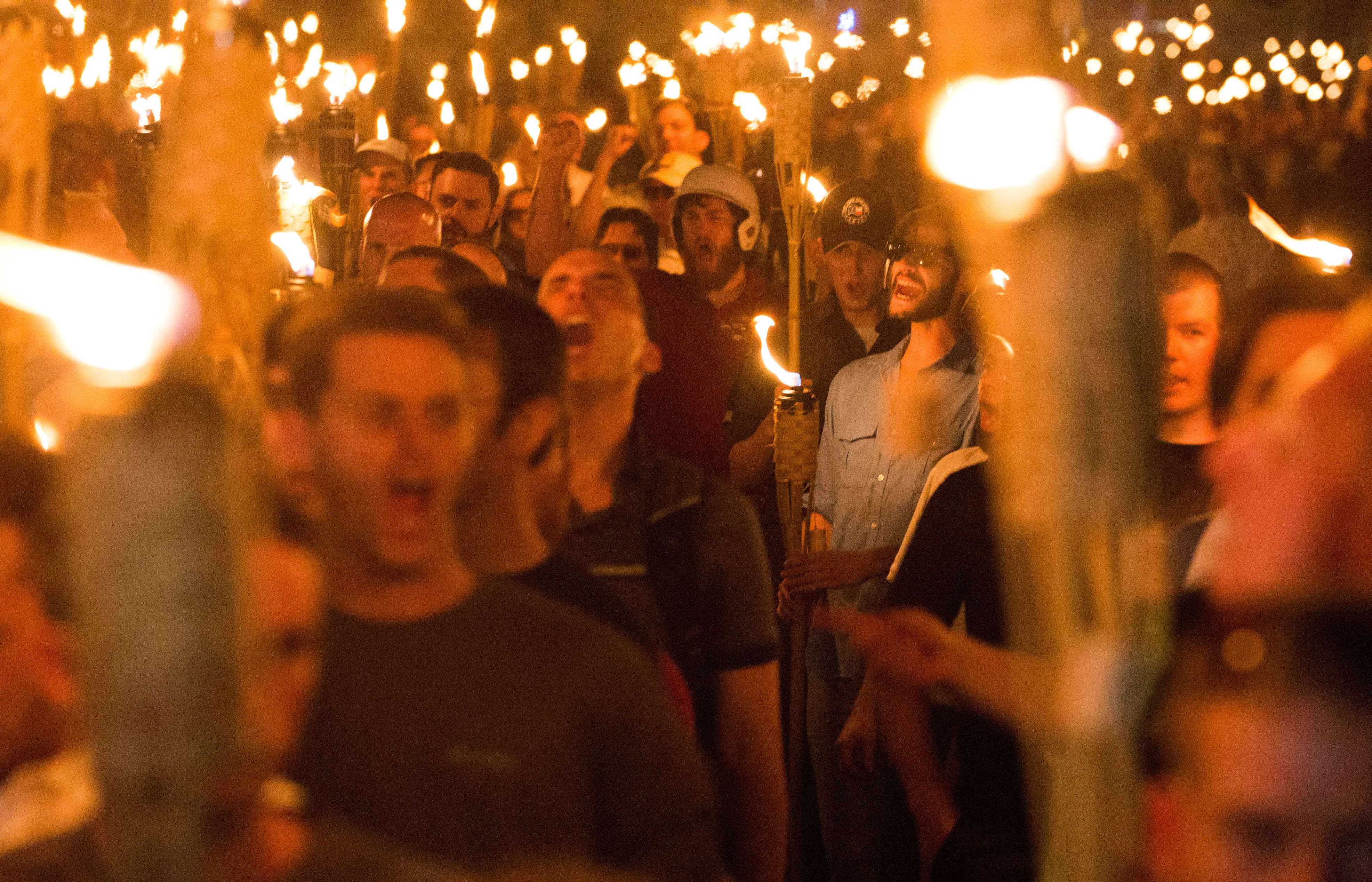
Mathias: In my experience there’s no one who was in Charlottesville that day—Nazi, antifascist, journalist, or otherwise—whose life wasn’t irrevocably altered by what happened there. For me, being in Charlottesville, seeing up close just how emboldened and bloodthirsty this honest-to-god fascist movement was, it was the beginning of a journey to investigate and unmask that movement, which at the time euphemized itself as the “alt-right.” That’s how I ran into antifa activists, who I realized were doing this work more effectively than almost anyone.
I think Charlottesville was radicalizing for me, and for so many other people. It was this inflection point where it all became real, that shattered a lot of mythologies America had about itself, and that I had about America: this idea that’s put into our heads that things are always changing for the better, that we don’t have to worry because we are on a steady march of progress, that things could never get as bad as they once were, or get as bad as imagined in some of our most dystopian fiction. I quote Shane Burley in the book about all this, and I think he hit the nail on the head, when he wrote that what happened in Charlottesville would either become “a symbol of trauma or the beginning of a rebellion against white supremacy.” I think we as a country are still navigating that. Still fighting over what we want that day to mean.
Your reporting makes clear that the most powerful tool that antifa has wielded over the past decade has been doxing—publicly exposing people as members of horrific, racist, far right groups. As the far right moves more into the Republican mainstream, do you think doxing as a tactic still retains its power?
Mathias: There is an ongoing battle in this country over shame. Doxing was effective for antifa because it leveraged existing societal taboos or shame about being an explicit white supremacist or Nazi, to create a social cost for being a fascist. It said to young white men, for example, sure you can join a Nazi group, but if you do that we are going to name and shame you to your communities and to your schools and to your employer and to your families. You’re gonna lose your job, your girlfriend, your family might shun you, and so on. This really worked there for a while, and I try to demonstrate in the book that doxing or unmasking this new generation of fascists—and antifa unmasked thousands of people—-effectively destroyed multiple “alt-right” groups.
The kind of animating question of the book though, is: what happens when that taboo against explicit white supremacy starts to disappear? There are examples in the last few years before the 2024 election of anti-fascist doxes having diminishing returns, or Nazis getting unmasked and communities collectively shrugging their shoulders. All the propaganda and talking points of the alt-right had gone mainstream. You heard the GOP talking about the “great replacement” and “remigration”—which is just a euphemism for ethnic cleansing.
But I think anti-fascists would argue that doxing and researching the far right is still incredibly valuable. Not only because it’s important to warn communities who among your neighbors is a fascist, but because it’s a battle to preserve and maintain and create that shame.
Recently Tom Homan, the head of ICE (who I once interviewed about attending one of Nick Fuentes’ white supremacist conferences) went on Fox and warned people protesting ICE: “We’re going to create a database. Those people that are interfering, we’re going to make them famous and put their face on TV. We’re going to let their employers and their neighborhoods and their schools know who these people are. I bet you a lot of their employers don’t know what they are doing.” It’s basically the premise of my book flipped on its head. That’s what I mean when I say there’s a battle over shame in the country, and what should be considered shameful.
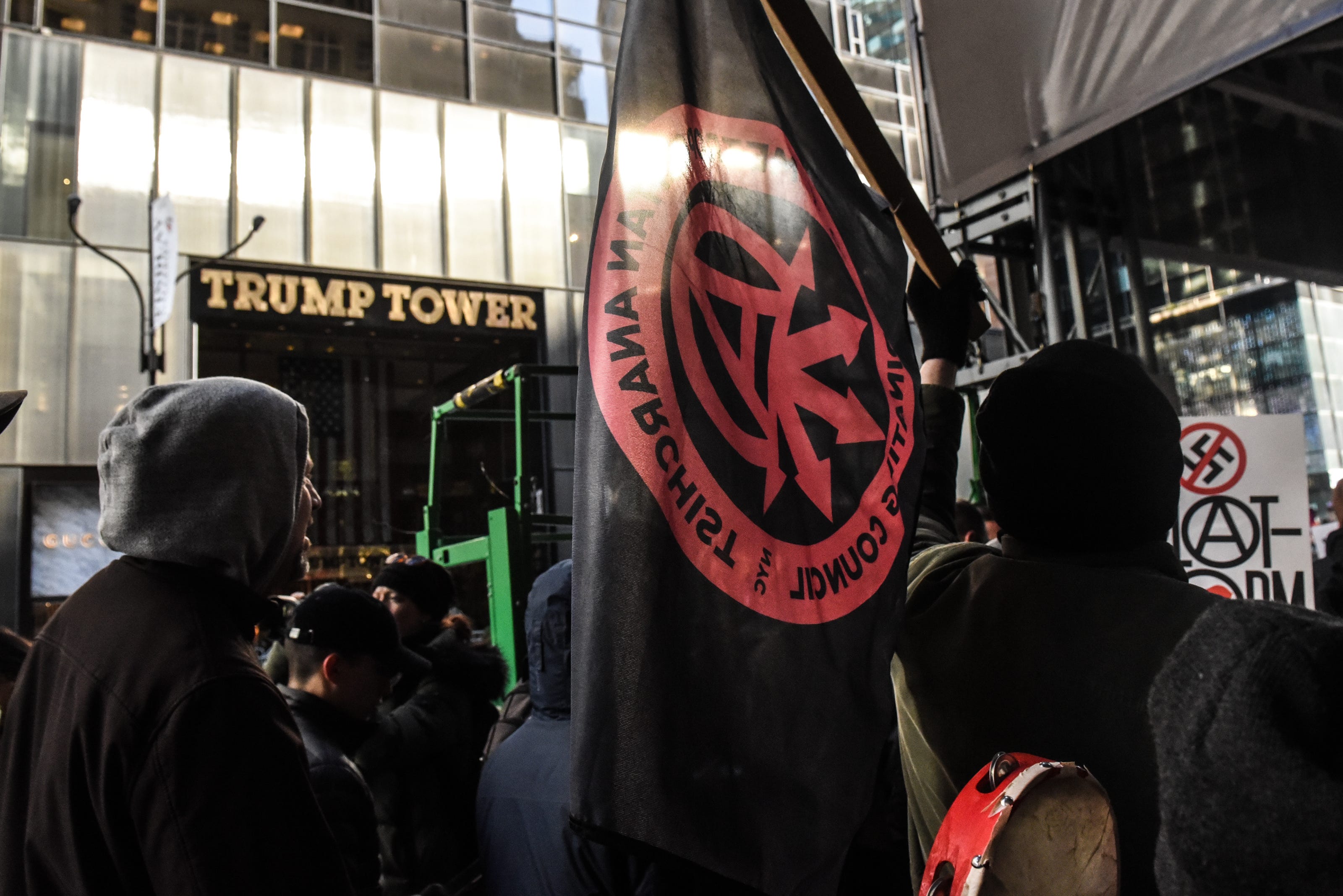
Among mainstream Democrats, there’s always been a tendency to put forward some false equivalence between antifa and those they oppose—often on the basis that antifa’s efforts to shut down or deplatform the far right are acts of opposition to free speech. You write that this only applies “if you understand free speech to mean speech without consequences.” How do you think about the role of free speech in the contest between fascism and antifascism?
Mathias: I remember back in 2017 when Richard Spencer—the alt-right poster boy best known for getting punched during Trump’s inauguration—was doing his campus speaking tour, he and the mainstream press made all these overtures about the importance of free speech. That he needed to be allowed to speak on these campuses because of the First Amendment, etc. But then Spencer was talking once on a livestream and one of his minions/lieutenants asked him something like “Do we care about free speech?” and Spencer quickly said something like “of course not.” That’s the thing: Nazis don’t give a fuck about free speech. They want to silence all kinds of marginalized groups permanently, whether through death or expulsion or other means.
Yes, antifa will punch Nazis sometimes, and yes antifa believes that fascists should have “no platform” to speak or organize, but the analogy I make in the book is this: if you’re in a bar, and a dude comes in shouting racial slurs and sieg-heiling, you understand that that dude poses an urgent threat in need of confronting. That he is liable to hurt someone. I think a lot of Americans in that situation would tell that Nazi to leave, and if he refused, physically force him to leave. I don’t think that dynamic changes because the Nazis decide to march in the streets. They always pose an urgent threat.
The right, MAGA and the GOP, along with so many of our most respected newspapers and centrist columnists, in the Times and the Atlantic and elsewhere, including the Harper’s Letter signees, have been on this decades-long project to conflate “free speech” with “speech without consequences.” The biggest threat to free speech, we were told, was virtue-signaling leftists on college campuses. That whole project was always infuriating, and it was always a cover to push the greater acceptance/allowance of racism, but that whole project has been rendered increasingly absurd when you have the Trump administration abducting someone like Rameysa Ozturk off the street and sending her to a detention center to await expulsion because she wrote a fucking op-ed for a student newspaper.
You’re a reporter who does what I would regard as very straight reporting. At the same time, you don’t pretend to have no viewpoint on the merits of antifascism. How do you navigate being a journalist who is up front about your political beliefs?
Mathias: Thanks for that. I really don’t think the two—straight reporting and being openly or even militantly anti-fascist—are mutually exclusive. And I’m really proud to be open about it in this way, and to be among a lot of journalists who are open about it in that way these days.
Journalism as an institution blows so much smoke up its own ass. It loves to talk about how important it is, that it’s the Fourth Estate, that it serves the public good, and that it is the public’s advocate. We give ourselves awards for this stuff. And the thing is, I earnestly, even cringe-ily, believe in all that. But how can you serve the public good by running interference for fascists? By both sides-ing fascism and those opposed to it? By pretending that things aren’t that bad or could never be that bad? By throwing already marginalized groups under the bus? By pretending you don’t have a stake in this? I just reject the notion of objectivity, or that there is a “place from nowhere” in reporting on all this. That doesn’t mean I’m not fair or even sometimes sympathetic towards those who I find reprehensible. It doesn’t mean I’m not gonna not accurately report shit. It just means that I live in New York and I can’t walk two blocks without looking at my neighbors and my friends and my loved ones and realizing that they are all at risk by what’s happening, by whatever iteration of fascism this is. That I have a stake in all this and that it’s better to be honest about that.
As for navigating it professionally, I’ve come to terms with maybe never being hired at the New York Times.
A decade ago the idea of declaring antifa to be a “domestic terrorist organization” seemed absurd. Today it’s a reality. Do you see antifa as the canary in the coal mine of authoritarianism in America? What do you think people who think of themselves as middle-of-the-road liberals have to learn from the way that antifa is being treated by the Trump administration and its allies?
Mathias: Trump declaring antifa a “domestic terrorist organization” in September—even though there is no federal statute by which to make such a designation—was the culmination of this nearly-decade-long MAGA effort to manufacture this antifa bogeyman. For MAGA, this bogeyman has been used to create this false equivalence that says “well sure the right is violent, but you guys are too!” It’s this absurd whataboutism with no basis in reality. Basically MAGA screaming “well you started it!” like a little child.
The bogeyman is useful for MAGA, because it distracts and deflects from the right’s very real violence, while also providing a pretext for MAGA to target its opponents with very real violence. Throughout the George Floyd uprisings of 2020, again and again you’d see these fake antifa rumors—about “busloads of antifa” roaming the countryside, or antifa starting wildfires—creating the pretext for the far right to essentially occupy entire towns. In places like Sandpoint, Idaho you had armed militias patrolling the streets. There were so many cases, Kyle Rittenhouse being the most famous, of these far-right militias showing up armed to intimidate protesters.
Do you remember Martin Gugino? I write about him in the book. But he was that elderly man at a small BLM protest in Buffalo in 2020, who was shoved over by riot cops, and you could hear his skull crack in the video. Gugino was a peaceful Catholic Worker protester. Steeped in nonviolence. He’d turned up to see if cops might pray with him for fuck’s sake. Instead they put him in the hospital during a deadly pandemic. None of that mattered though afterwards. When Trump realized the video was a bad look, he promoted a bullshit OANN story that Gugino was antifa. This was a way of saying what happened to Gugino was fine and justified.
It’s a similar dynamic with Renee Good and Alex Pretti, both of whom we watched get shot and killed, and then labeled “domestic terrorists” after the fact. Even though they were being peaceful, it didn’t matter. And even if they hadn’t been completely peaceful, that doesn’t mark them for summary execution! What those murders made clear was that Trump and MAGA will label whomever opposes them as “antifa” or “domestic terrorists” as a way of justifying their subjugation or murder.
This antifa bogeyman only works though if people kind of immediately to the right of antifa, and leftists more broadly—that is, liberals and centrists—abandon them. It’s the same reason MAGA targets trans folks and immigrants and other marginalized groups. It’s because they know liberals might not show up for those groups fully, and that these groups can be peeled away and subjugated or disappeared or expelled. It’s a method of divide and conquer. It’s why it’s so important for normie libs or whatever you want to call them to show up for all of these groups so utterly and completely. It really is the Niemholler poem that gets bandied about. “First they came for the socialists…” I actually believe we are living through that.
I wrote recently for the Nation about how liberals and centrists and Democratic politicians have this annoying habit of saying that antifa doesn’t even exist—that it’s just an “idea” and that “antifa” is simply a shortening of antifascist. I just wrote a whole book about antifa. It exists, and I think antifa is worth defending, and that liberals need to give antifa solidarity. MAGA is labeling antifa “domestic terrorists” for now, but it will give liberals or whomever opposes MAGA that label tomorrow.
Is America fascist today?
Mathias: Yeah definitely, but then again, like I said earlier, America has always been fascist to some degree. What’s happening now is an intensification of our social hierarchies, an attempt to reify them, to make them permanent. It’s the process of making all these implicit social arrangements and hierarchies in American life explicit.
I just had a podcast interview to promote the book, and I didn’t know much about the guy interviewing me, and he kept trying to trip me up, basically being like: “so are you saying the millions of people who voted for Trump are fascist?” And I really stumbled through my response, because I believe that yes, MAGA is fascist, that Trump is a fascist, that the GOP is a fascist, that as a political party it is pretty irredeemable at this point. All that said, there’s still something hard for me to imagine calling all the Trump-supporting people I grew up with fascists. Would I call them that to their face? Maybe I should. I think I still reserve the label for those most actively MAGA, for those actively involved in this GOP, but yes, millions of Americans who support this president, who support MAGA, they are part of a fascist movement. Even if many of them are starting to learn they were sold a bill of goods.
I think what’s been frustrating these last few years is this insistence among the pundit and chattering classes that the some scariest words in our language—fascism, genocide, concentration camps—should almost never be used, lest we diminish them. That they only apply to these very specific historical periods. But I think the reason we have those words is to use them! The lesson of the Holocaust is not “never again” because it couldn’t possibly happen again; it’s “never again” as in “we have to be fucking vigilant that this never happens to anyone again ever.” That’s why it’s important to call what’s happened in Gaza a genocide. It’s why it’s important to call ICE detention centers concentration camps. It’s why it’s important to call Trump and MAGA fascist. These are all five-alarm fires, the biggest moral emergencies. They deserve our scariest words so we can stop them.
For those still resisting using the term, for insisting that America is not fascist, I keep thinking of that footage last week of all the people in the detention center in Texas in similar outfits, waving their arms at a camera in the sky, to protest the squalid conditions they are being kept in. There were children in that video. I don’t know how you look at that and don’t immediately think of the Holocaust photos we all grew up with. Sometimes I want to tell people who aren’t calling this shit fascist: Okay, go to that concentration camp and scream over the wall, “It’s okay! Don’t worry, this isn’t actually fascism!”
Final thing on this: there’s been this tendency over the last few years, even among leftist pundits, to be like “well if it’s fascism, then where’s the militant resistance?” Basically calling out those calling this fascism for not picking up arms or some shit. But I don’t know man, look at what’s happening in Minneapolis, and how can your heart not fill up with what we’re seeing there? What is happening there is an honest-to-god anti-fascism, a militant anti-fascism that is confronting fascists in the streets. That’s monitoring this secret police. That’s pressuring restaurants and hotels not to serve ICE. There’s this popular front forming, of lefties and normie libs joining together, realizing that no one is coming to save them. That the cops and that the Democratic party isn’t going to protect them from this. It’s that axiom “we protect us” in action and I think it’s beautiful. There’s a reason the resistance in Minneapolis is driving Trump and MAGA mad—and it’s because that type of resistance is going to win.
I talked to an anti-fascist recently who told me: “Antifascism is a natural response to state terror. Antifascist action belongs to the people. Anyone can do it. Every day this goes on, DHS creates thousands of new antifascists.” I believe that too, and I believe earnestly, cringe-ily, that these fascists are bound to lose.
You can buy “To Catch a Fascist” wherever books are sold.
More
Previously in How Things Work author interviews: Tom Scocca, on media and mortality; Megan Greenwell, on private equity; Stepanie Kelton, on economics; Jeff Schuhrke, on labor and foreign policy; Eric Blanc, on worker organizing.
For those of you who follow my boxing writing, I have a new piece at Defector about the Shakur Stevenson fight at Madison Square Garden, and about having a good attitude. In it I mention one guy with a good attitude, Dan McQuade, a fine writer who passed away recently. You can find out more about Dan’s life, and donate to support his family, at this link.
Thank you all for reading How Things Work. This place exists only, 100%, thanks to the financial support of all of the readers who choose to be paid subscribers. That is the revenue that keeps us publishing, that keeps the site paywall-free, and that allows me to go out on the road reporting, as I’m about to do this week. If you like reading How Things Work, take one quick second right now to click the link below and become a paid subscriber. Not too expensive, and good karma. Peace.
Greetings from the Twin Cities. My bona fides: I'm staff for an education union. Worked in labor politics (member-to-member, not a lobbyist) for just under 20 years. I'm also a union member. The local I work for is very left-ish. I'm also a union member. I have lived in MN since the 80s. Raised my kid here. And I've been around the work since I was in my late teens.
I want to add what I think is important context to Mathias' assessment of what's happening here. I also want to be clear that I believe that MN was always the target, and that what happened in LA, Chicago, and Portland were test runs.
Minnesota is different from those places in a lot of ways. We're smaller, and more isolated. We're flyover country, which means folks don't pay much attention to us - think about how much national press attention we got for our 1/23 general strike outside of niche news outlets While people were going apeshit over how cold and snowy it was going to be, there was very little mention about how dangerously cold it was, and there were 50K people outside for hours here. The weather here (and not just winters) forces you to learn patience and to build stamina that goes deep.
A lot of the usual tribalism amongst labor and between labor, faith, and progressive orgs don't hold up here. There's still some of it, and a lot of us have been working to address that since 2018-ish. Yes, we still have gaps and problems. And unlike a lot of places, we're actually trying to address that. We're fundamentally a pro-worker state. (A union state too, but that's a little different).
When folks that aren't from here write or talk about MN, you'll often hear "a deep blue state, in a red part of the country". And precious little analysis goes into that.
We're standoffish people (it takes a while to get to know us), but we know who our neighbors are. We'll push out our asshole neighbor's care when it gets stuck, and we'll shovel a stranger's sidewalk. (Because we know that the weather here can kill you, and that regular ice can leave you with a broken leg). We value our parks - not just cool state parks, but the little city park down the block, and we have lots of those. Outside of our cities and farming communities, we are shockingly white. And we have been aggressively pro-immigrant for decades. (Ya think people come here for the weather?)
But I really think, in this moment, what has made the difference is COVID and the murder of George Floyd. These two events, showed us that we had a choice to make in how we move forward. They also broke a lot of right-wing brains.
Like a lot of cities, mutual aid groups came together here at the start of the pandemic. But those groups were really tested over the summer, especially after the National Guard was deployed in our streets. What a lot of people either forget, or never knew, what how fascists came to our state during the Uprising. A lot of folks don't know, or care, that it was a Boogaloo Boy that kicked off the destruction around the 3rd precinct. Many aren't aware that in our Black neighborhoods, folks set up patrols (sometimes armed) to protect their communities from real outside agitators. And - I think this is really important - folks don't understand that the legislative wins that Walz gets the credit for was actually only possible because of those coalitions I hinted at at the start of this.
We also learned a lot after the Uprising. Especially about how groups are marginalized and infiltrated. We learned to think more deeply about tactics, and keeping each other safe. And we didn't wait to see what would happen after the 2024 election. We knew we were going to be a target. Not just because of Trump's insane levels of entitlement, but because we lived through the response to us in 2020.
Basic organizing principles aren't just for getting a good contract. They translate pretty well to politics (if you actually focus on the politics and not just elections). One thing the boss knows is that if you want to break worker power, you go after the tightest, strongest one. You can break the weak unions, the business unions left and right, but you don't get rid of unionism that way. We may be a smaller population, but we are also deeply rooted in shared values and strong relationships in ways that larger populations are not. They have to break us here, if they want the rest of you to fall.
I spend a good part of each day anxious. I've cried every day in my car since the occupation started. I worry every day for kids that were already reeling from the pandemic who are now breathing in tear gas outside their school. I worry about what will happen when the leg session starts in two weeks (don't forget, we had our Speaker murdered, and another long-time state Senator badly injured). And every day, my fellow Minnesotans give me hope.
This is the most encouraging material I have read in weeks. Thank you.