
Brutal Oppression and Beautiful Humanity Exist In Every Grocery Store
An interview with Ann Larson about "Cleanup on Aisle Five"

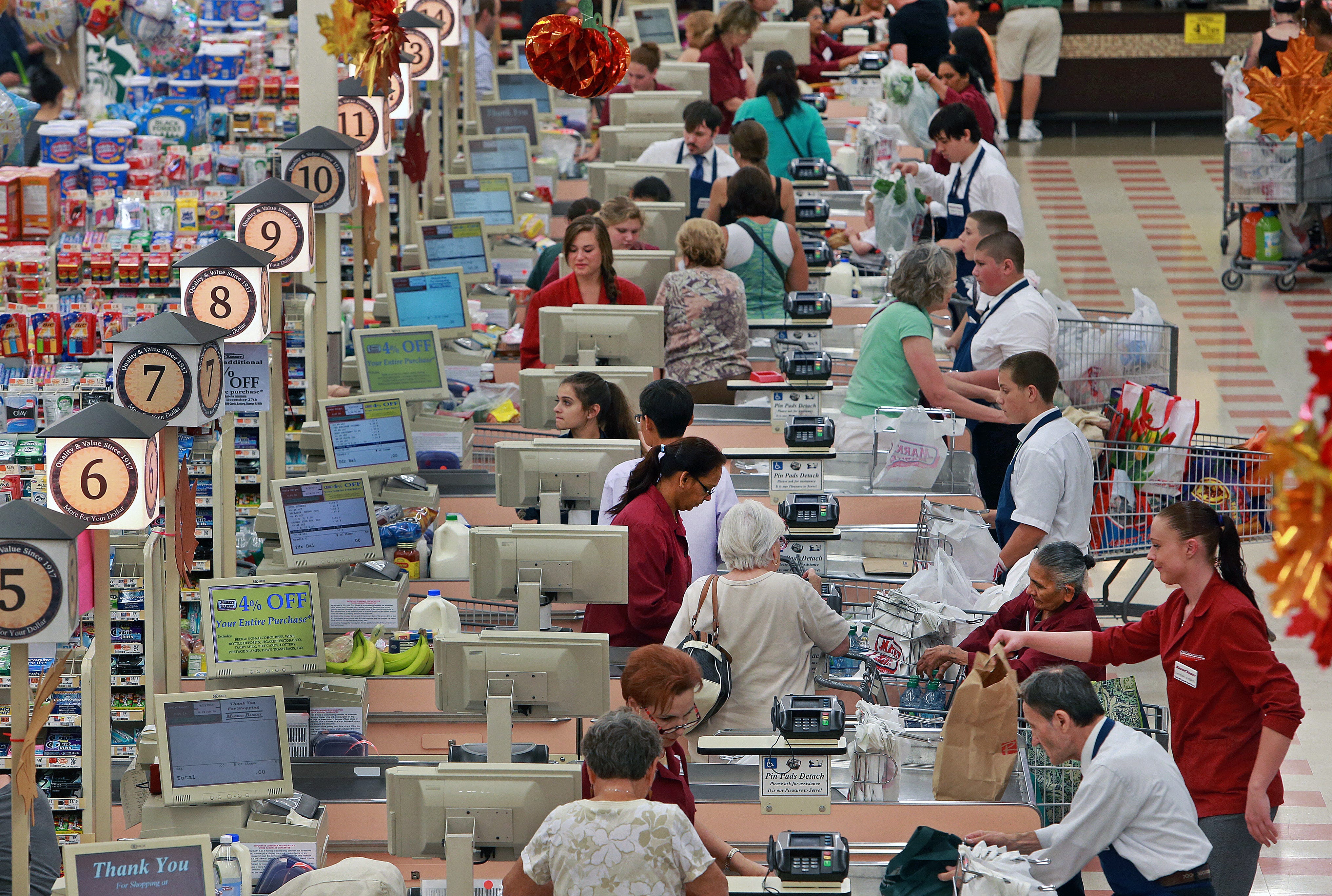
I have always found grocery stores fascinating—both as endpoints of a staggering global web of logistics, agriculture, and commerce, and as labor stories. So I was enthralled by Ann Larson’s new book “Cleanup on Aisle Five,” a first person account of working in a grocery store during the course of the pandemic, which was just published this week.
Larson, a writer, academic, and cofounder of the successful activist group Debt Collective, writes in the tradition of workplace classics like Barbara Ehrenreich’s “Nickel and Dimed.” And Larson is no poverty tourist. She found a job at a grocery store in Utah in the fall of 2020 out of economic necessity, and worked there long enough to experience firsthand the struggles endemic to the industry. I spoke to her about class, service industry labor, and the harsh realities behind the smiles of your grocery store cashiers.
How Things Work: In your book’s conclusion, you write, “I urge my college-educated peers to abandon the idea that our degrees entitle us to live lives of dignity denied to others.” Given your background, were you surprised when you ended up working in a grocery store? Or did it strike you as a pretty natural thing, given the precarity of the American economic system, which you know well?
Ann Larson: I was not surprised. My life as a white collar professional had always been precarious. I had experienced what people call “downward mobility” on a couple of fronts. I had wanted to be a professor, but the adjunctification of higher education made full-time jobs nearly impossible to come by. As a cofounder of the Debt Collective, I saw firsthand how difficult it was to maintain the organization financially in a system where fickle foundations call the shots. In some ways, the supermarket job was the most stable work I had had in years! But knowing that I had fallen down the class ladder did not mean that I felt that retail work was beneath me or that I deserved better because I had an education. As a person of the left, I knew that meritocracy is a myth, and that social class explains people’s occupational outcomes. I still hoped that I would be able to maintain my hold in the white collar world. But I had run out of options.
You’re an experienced organizer, and you write about the benefit that a union would have brought to the grocery store. But ultimately you decided not to try to organize one in your time there. What was it about the nature of the workplace that led you to that decision? Was UFCW, America’s biggest grocery union, a presence in your area, or not really?
Larson: I worked in Utah, what the right wing calls a “right to work” state, where there are high barriers to organizing a union. To my knowledge, UFCW was not in the community. I didn’t know any other stores that were unionized. Moreover, in my 13 months on the job, I never heard any employee use the word “union.” I write in the book that collectivizing our struggles felt foreign, even dangerous, as if the idea existed in another universe.
Given this context, the main reason I did not try to organize was fear for my colleagues. I knew that it was illegal to fire workers for trying to unionize, but what if the store fired people anyway? I couldn’t imagine putting my colleagues at risk so that I, someone who did not plan on making a career at the supermarket, could impose my view of what needed to happen. I have only become more convinced in recent years that organizing in retail will require a big support system outside stores. Shoppers and community members are going to have to do some of the heavy lifting such as raising money for a strike fund, making it clear they won’t shop at a non-union store, and providing other kinds of solidarity. The idea that retail workers are going to carry the burden alone, even with the support of professional organizers, is a fiction.
You write eloquently about the dilemma of being a supervisor, and how that challenged your own ability to think in terms of solidarity with your coworkers. I liked the descriptions of your own internal struggles as you tried to reconcile your own day to day responsibilities at work with some of your broader beliefs. Why is it so difficult to build solidarity in that sort of environment, where every tiny microlayer of management is designed to enforce the company’s rules on everyone below them?
Larson: The supermarket is an open, quasi-public space where anyone can come and go. But in another way, it is a closed universe that operates according to its own laws. I came into the store with an understanding that working people were exploited by employers who extracted labor for profit. But that idea—as true as it was—didn’t provide a road map for how to manage the store.
I tried, for example, to be a “laid back” supervisor. At first, I didn’t complain when cashiers and baggers extended their break times or took a long lunch. I figured people were tired and hungry! But I quickly learned that allowing one person to break the rules put pressure on others. If someone came back late from a break, the cashier who was next to go had to wait. And if everyone took a long lunch, then we would be short staffed which forced people to work faster.
Enforcing the law was the only way to be fair. But it could also come off as rigid and inflexible. Such contradictions meant that it was impossible to reconcile my beliefs with daily life on the job. It wasn’t until I left the store that I realized that an effect of the hierarchy was that one person’s perk always came at someone else’s expense.
You worked at the store during the pandemic, and you discuss the fact that grocery workers took enormous risks to keep the public fed during that time and got virtually no permanent gains for themselves as a result. That’s always struck me as one of organized labor’s greatest failures of the pandemic era. Can you see any way that that might have turned out differently, or is the power of workers in the grocery industry just too weak?
Larson: I share the view that labor failed to take advantage of the pandemic as an organizing opportunity. This was a moment when unions could have made demands. I don’t have enough of an inside view of the labor movement to know why that didn’t happen. I do remember a lot of fighting about culture war issues, some related to the pandemic and some not, that took up most of our public discourse at the time. Zooming out a little further, I see labor’s failure as symptomatic of the Democratic Party’s abandonment of working people in favor of a politics focused on professional class concerns.
Grocery stores seem like miracles of logistics and modern convenience. You write about both the ways that supermarkets made life better for Americans, and the ways that much of that convenience has been built on the abuse of the grocery work force. Tons of your coworkers were broke, sick, injured, or all of the above at any given time. What do you think would most surprise the average shopper about the way that the people at their local grocery stores are treated? And why the hell can’t cashiers sit in a chair???
Larson: Shoppers might be surprised to learn that cashiering is dangerous. I was shocked at the level of suffering that I observed and experienced. Scanners allow cashiers to work fast which is a convenience for customers. But scanning leads to pain in the arm, hand, and wrist. And standing leads to back and foot pain. (When I started the job, I was told that cashiers had to stand because a standing worker looks more eager to serve.) It’s extremely difficult to get any kind of workers comp or disability. One reason is that OSHA, the federal organization that is supposed to protect workers, has been underfunded for decades. A bipartisan failure. Cashiering looks like a chill, easy job. But I want shoppers to understand that when they walk into a supermarket, they are walking into a meat grinder that is churning through bodies for convenience and profit.
Making grocery (and other service industry) jobs more humane and livable is one of the deepest challenges in American labor. What do you think would move the needle the most on this, in terms of government policy? In terms of organized labor’s own actions? And in terms of actions that individual shoppers can take?
Larson: Unionization is at the top of my list of what can move the needle. If I could flip one switch tomorrow, I would eliminate “right to work” laws that have made states like Utah so hostile to organizing. I would also like to see an increase in the federal minimum wage which has not been raised since 2009. Raising the minimum would communicate to employers that they can no longer get away with paying as little as possible.
In terms of organized labor, my experience confirms something I learned from your book, “The Hammer.” Unions should invest more in organizing at the grassroots level. I suspect that one reason no one at my store ever talked about unionizing is because they had never been approached by an organizer. When it comes to shoppers, I urge people to get to know who works in their store. Say hello to your cashier and ask how she is doing. Those of us who don’t work in stores should also get ready to support retail workers on strike. We can refuse to cross picket lines, donate to strike funds, and communicate to stores that we won’t shop in outlets where workers are not unionized. Organizing in retail can’t be done by workers alone. It’s going to have to take all of us.
You can order Cleanup on Aisle Five from an independent bookstore at this link.
More
Previously, in How Things Work author interviews: Megan Greenwell on private equity; Chris Mathias on fascism; Jeff Schuhrke on labor’s foreign policy; Eric Blanc on organizing; Tom Scocca on mortality. Also, on groceries as a labor story: In 2021, I wrote a profile of the workers in a single grocery store over the first year of the pandemic; and in 2024, I profiled the insurgents trying to reform the UFCW from within. Larson and I have both been fellows at the excellent Economic Hardship Reporting Project, an organization that supports journalism about these sorts of issues.
The Labor Notes conference will bring thousands of labor people to Chicago this week. If you’re going, great news: My friends at In These Times magazine are sponsoring an after party on Sunday, June 14, featuring me, Alex Press, Kim Kelly, Max Alvarez, and music and comedy more. Get your tickets right here. See you there hell yeah.
Have you ever wondered, “How is it that independent media can keep existing in this time of techno fascism and the increasing capture of the media industry by rich bastards?” Maybe not. But, if you have, the answer is: “Because readers like you chip in a few bucks to keep independent media going.” Without that, there will be nothing but Bari Weiss and Elon Musk left. If you enjoy reading this site and want to help it keep on existing, take a quick second right now and click the button below to become a paid subscriber. If we all give a little, we can do big things. Thank you for being here.
My partner worked in a unionized grocery co-operative during the pandemic, and the frontline employees there received hazard pay of up to $5 more per hour. This benefit did not last long, but it was significant for us. Those early months of the pandemic in the grocery store were wild. Everyone was so stressed and afraid, employees and customers alike. Customers were desperate for canned beans and other shelf-stable staples and bulk goods (he was the bulk supervisor). Plus there was so much we didn't yet know or understand about covid. As a precaution, there was a period where he would come home at the end of the workday, strip his clothes off at the door into the dirty laundry, and immediately shower.
It’s about time that somebody made the public think about Grocery Store workers and what they do, and I do wonder what the thumb sucking pigs who are doing all they can to wreck the lives of workers and all Americans ever think about the people who work long and hard to make sure there is not only plenty for the customers but chairs for cashiers and everyone else in the store. Thank you.