
Labor Movement, Attack!
Another year of decline. Here's how to fix it.

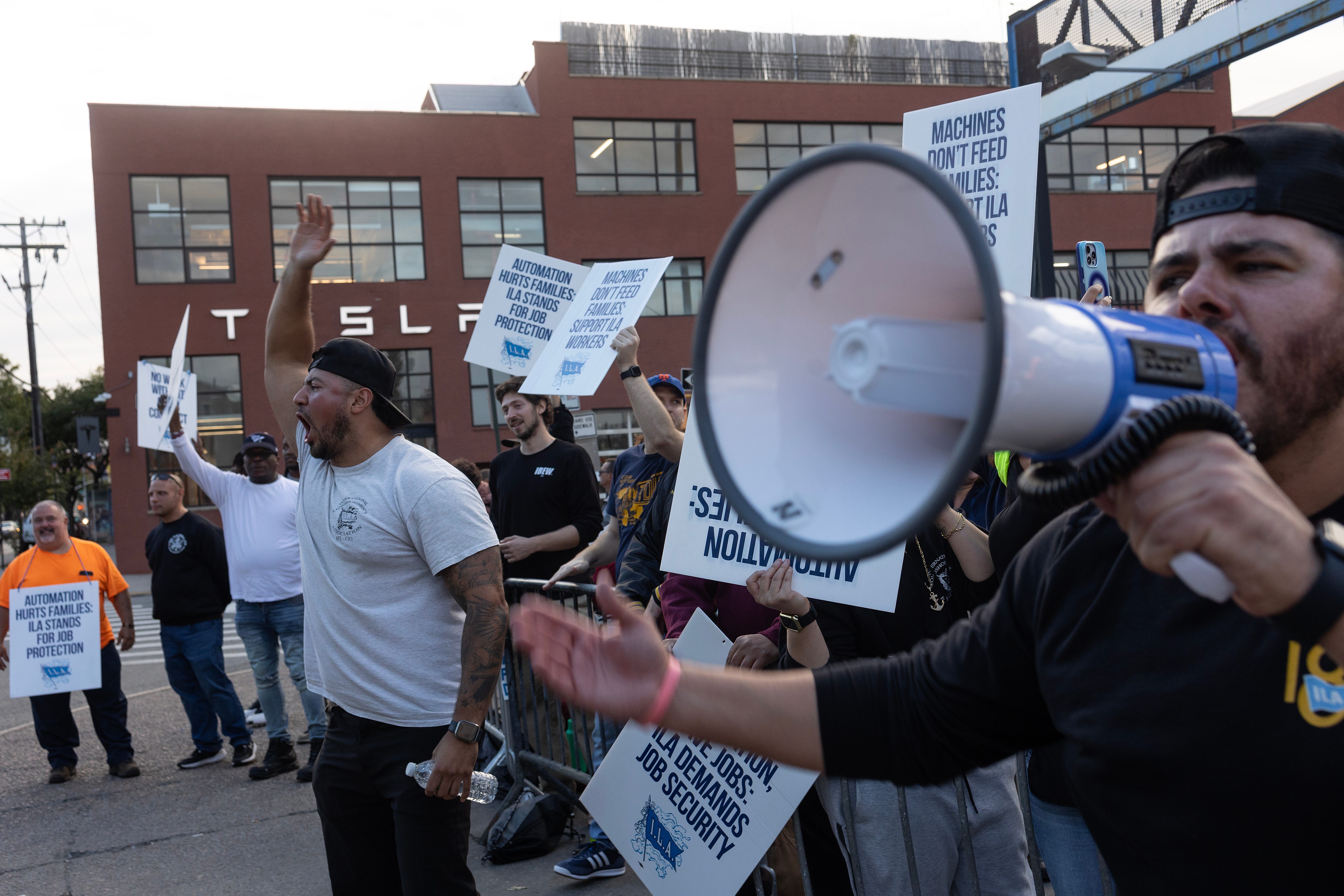
Union density—the percentage of American workers who are union members—is the single most important measurement of labor’s power in its omnipresent war against capital. Every year, the Bureau of Labor Statistics releases an annual measurement of union density. It is a hard, numerical gut check of where the labor movement stands.
This year’s report, out today, shows union density at 10%. That is a combination of a full one-third of public sector workers being unionized, and a paltry 5.9 percent of private sector workers. These numbers are relatively unchanged from last year (a 0.1% increase, to be exact), although there is some evidence that data collection failures by the current government may have affected the numbers by a small amount. The relevant takeaway from these numbers is: Once again, union density did not meaningfully go up.
Declining union density is not new. It has been declining, with only brief and small interruptions, since the mid-1950s, when more than one in three workers was a union member. Nor are declines merely the result of Republican administrations persecuting unions harder than their Democratic counterparts. Joe Biden was the most pro-union president of my lifetime. He appointed unusually pro-labor officials to regulatory agencies—and union density still declined during his presidency.
Turning around this decades-long decline of union density is the labor movement’s most important task. If we do not do it, we will quite literally shrink down into utter irrelevance. We will fail at our central job: building power for working people. Giving workers unions—the tool that they can use to wield power on their own, without asking permission from anyone else—is the first job of all of us who consider ourselves a part of the labor movement. Union density under ten percent is a collective failure. We need to stare it squarely in the face if we are ever going to change it.
There is no doubt that America’s awful labor laws, crafted to make it hard to organize unions, hard to sustain unions, and hard for unions to exercise their power, are the most responsible factor in union power’s decline. But. But! Given the fact that we are approaching the 80th anniversary of “trying and failing to reform America’s bad labor laws,” common sense dictates that we had better pursue strategies to increase union organizing in the environment we have, rather than forever vowing to do it just as soon as we change something that we have never been able to change. Yes, we must continue to try to pass the PRO Act, and yes, we must continue making state laws more pro-union in blue states where we are able to. But ample evidence over many years shows us that the question to ask ourselves, even during Republican administrations with hostile NLRBs, is “What can we do that is within our control?”
By this standard, the controlling institutions of the labor movement (to the extent that they exist)—the biggest unions and the AFL-CIO—have also failed. Yes, Trump has been the biggest union-buster in history, and his unrestrained attacks on both public and private sector union power are staggering.
Was there a coordinated strike in response to the Trump administration’s decision to blatantly tear up existing union contracts covering tens of thousands of federal workers? No.
Have we built a big national strike fund, to make it easier for existing unions to exercise their power right now? No.
Have we built a functional coalition of major unions to jointly fund and carry out major organizing campaigns at big employers like Amazon or Walmart? No.
Have we built a new union dedicated to organizing the tech industry—America’s richest and most powerful industry, which is almost completely untouched by union power? No.
Most straightforward of all, have unions drastically increased their funding for new union organizing, in order to provide the organizing resources that we know are necessary to turn around union density’s decline? No.
My point here is that our response to each annual report on union power’s decline cannot just be hand-waving about how the government is not friendly enough to us. The entire point of having a strong labor movement is for working people to be able to exercise power without asking the government for it. Our own power. Nothing I am saying is a denial of the challenges we face, nor of the depths of the awfulness of the Trump administration. We are in a fight. And we are losing. Capital is winning its economic battle against labor. We can either do things differently, or continue to get our asses kicked.
We know how to organize new unions. It is not a secret. It can be done now, regulatory environment notwithstanding. Organized labor’s leadership needs to collectively 1) Get the money (from their existing budgets, and by identifying new funding sources) to do a lot more organizing, and 2) Spend it on organizing. See? Hard, but not complicated. The fascist political environment we are in makes it more, not less, important to build union power. Look to Minneapolis, where local labor unions combined with a whole universe of community groups and activists to fight against ICE, and with tenant unions to organize a major rent strike in pursuit of affordable housing policies. A strong labor movement is the foundation of much broader social movements that can reach into all sectors of public life; a weak labor movement hurts working people not just in the workplace, but everywhere.
As a labor journalist, I have been privileged to witness the incredibly inspiring stories of fighting and sacrifice that you can find inside every single local union. Working people themselves have never stopped fighting. When I look at the top of organized labor, though, I see something worse than damage—I see acceptance. Acceptance of decline, acceptance of weakness, acceptance of the way things are. This is the quality that we must point to, and call out, and eradicate if we are ever going to have hope.
“Nobody ever defended anything successfully,” said General George Patton. “There is only attack and attack and attack some more.” This is the story of worker power in my lifetime. We can attack, or we can continue being slowly crushed in a war of attrition.
More
Related reading: We Are Failing; The Life and Death Stakes of Labor Power; How the Government Can Help Build Industrial Unions; Ten Times This; They Are Going to Take Everything If We Don’t Stop Them. I also wrote a book about this stuff, called “The Hammer,” which you can order wherever books are sold.
Yesterday I was on Seth Harris’s labor podcast with some other great labor movement guests, and you can watch that here. If you prefer to see me run my mouth in person, I will be in New Haven, Connecticut this Friday at 6:30 pm, speaking about fascism at the New Haven Teachers’ Union Hall. A fun night out for anyone.
I am grateful that thousands of you read about labor and politics right here at How Things Work. This place is a living example of the possibility of independent media: No corporate sponsors, no paywall, one hundred percent funded by readers just like you. If you like reading this stuff and want to help us keep on publishing in 2026, take a quick second and become a paid subscriber by clicking the button below. It’s a reasonable price for all the words you get. Thanks for being here.
Workers unite and organize! Unionization is essential in these times.
Amen!