
Prisoners of Fortune
When your money owns you.

What is the point of being rich? Most people’s answers would be some version of: To be able to do what you want. Money, at its essence, is a thing that gives you the ability to enact your will upon the world. It liberates you from life’s constraints. The more money you have, the more free you should be.
So it is odd to observe the ways that this is plainly not true. The more that fortunes swell, the more people seem to be owned by their money, and not vice versa. If you were a reflective sort of billionaire, it might be enough to make you question your most fundamental life choices.
In California, there is a well-organized campaign to enact a wealth tax. The proposed tax would be highly targeted. It only applies to billionaires—fewer than 300 people, in a state of 40 million. It is a one-time assessment, not an ongoing annual tax. Each billionaire who was a California resident as of January 1 would pay 5% of their wealth. The money raised would be earmarked to pay for health care for California residents, to make up for the federal government’s drastic cuts.
One reaction to this proposal—the reaction that a child, for example, might have—is, “Wow, that would cost the billionaire a lot of money.” Another reaction—the reaction that someone mature, emotionally developed, and financially savvy might have—is, “A one-time tax of 5% would be less than the annual increase in size of any well-managed fortune. Most billionaires would be able to pay this tax and still end up richer than they were the year before. This payment, unlike regular tax payments which cover lower and middle class people, would have zero material impact on the lives of any person who would be required to pay it. Its proceeds will go to a good cause. Happily paying the tax could be chalked up as the price of good PR during an age of unprecedented economic inequality.”
To date, we have precisely one example of a billionaire having the mature reaction. Nvidia CEO Jensen Huang is a California resident whose net worth is more than $150 billion. Asked about the proposed tax, he replied, “I have not even thought about it once. We chose to live in Silicon Valley, and whatever taxes they would like to apply, so be it. I’m perfectly fine with it.”
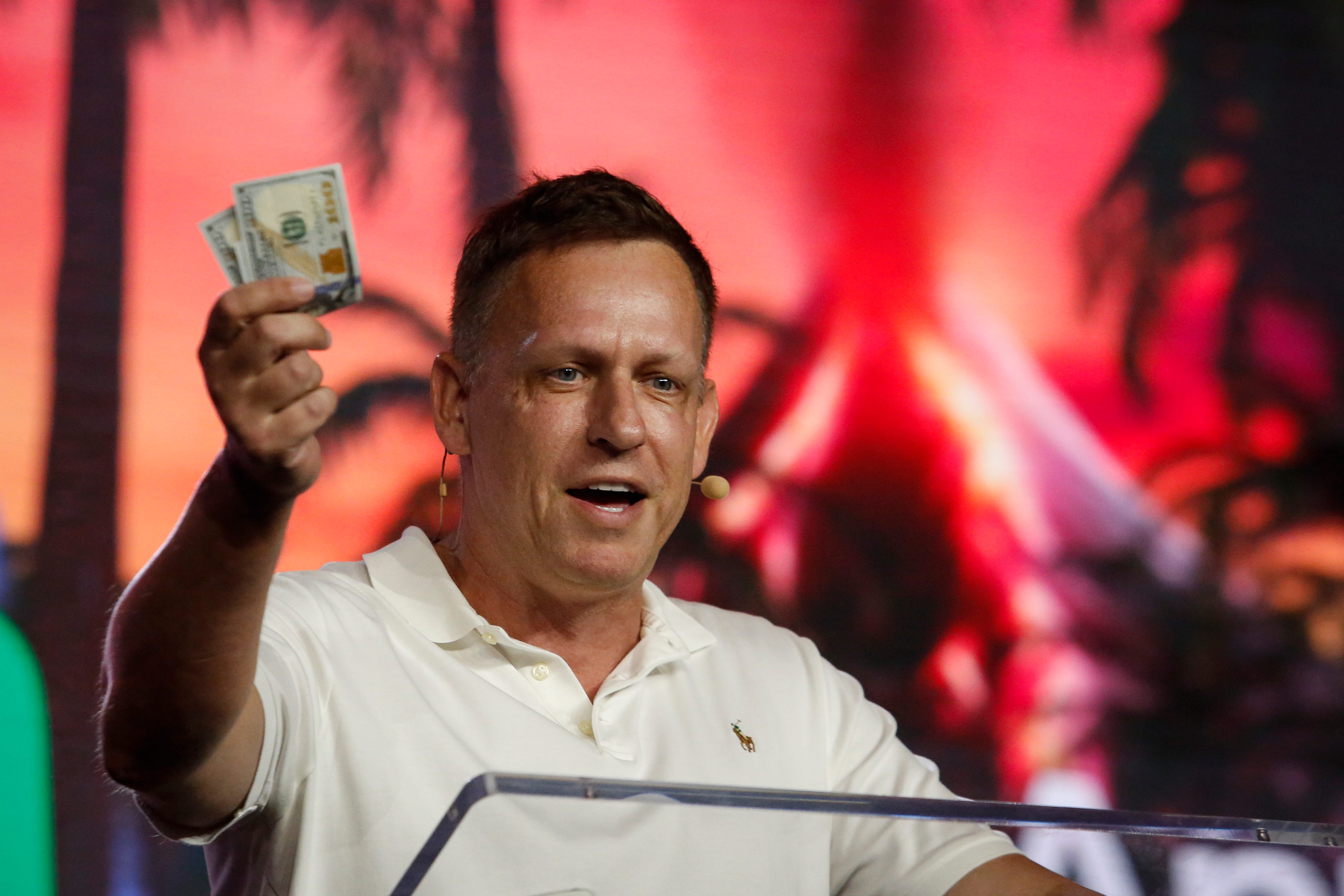
Virtually every other reported reaction to this proposal from the billionaire class has fallen into the other category. In a private Signal chat, they wail about “Communism” and discuss leaving the state. Peter Thiel is donating millions to fight the proposal, while planning to move to Miami. Joining him will be Google co-founder Larry Page, who just dropped $173 million on two Miami mansions. David Sacks is calling it an “asset seizure” and fleeing to Texas. Billionaires are threatening to primary Ro Khanna for his support of the tax, and leaning on political allies, including the governor, to speak out against it. Even though the proposal has yet to be placed on the state ballot, it has already generated a public freakout of historic proportions by the richest group of men on the face of this beleaguered earth.

Now, I support the hefty—even confiscatory—taxation of billionaires, for reasons that I have written about previously at great length. While there is a reasonable conversation to be had about the fairest and most effective way of designing a wealth tax, we should not allow that tactical discussion to obscure the larger fact that we will either take money from the billionaire class and redistribute it to everyone else, or watch our nation slip further and further into oligarchy and fascism.
But set that practical socioeconomic discussion aside for a moment. Think about something much more basic: The choice of where you live. All of us aspire to live in a place we love. Only some of us are able to. And here, in California, we have a group of the wealthiest people on earth, people who can live anywhere they want, and have who have chosen to live in California, because they presumably like it better than anywhere else. And these people are making the choice to move somewhere that they presumably like less than California in order to avoid paying a tax that will have zero material impact on their lives. They are voluntarily giving up what is ostensibly their dream life in order to better maximize their net worth.
What is that number in your bank account for? You get a certain number of days on this earth and then you die. Imagine being granted the ability to live out those days exactly where and how you wish, and then throwing away that ability because you want the bank account number—which you cannot ever use up—to be larger.
This is an insane act. This is Scrooge McDuck huddling in his private bunker of gold coins as the sun shines nicely outside on all the happy people. This is the most grandiose possible example of someone Missing the Point of Life.
It is illustrative of the curse of great wealth. There is some tipping point at which wealth becomes a burden rather than a blessing. The fortune that you thought would grant you all of your wishes becomes something that instead demands all of your attention. Your ability to live a life of leisure and good works is subsumed by your need to jealously guard your ever-expanding hoard of money, to watch it anxiously, to defend it from those who might take some from you, to protect it from anything that might take a nibble. Your life becomes a paranoia-plagued quest to maintain a status that long ago passed practical usefulness. These California billionaires, these kings on earth, these people who could live perfect lives while also doing great acts of charity, end up as bitter, angry Gollums, struggling to drag their enormous sacks of gold down the road to more desperate locales. Without ever noticing, they give up the freedom that their money was supposed to be earning them. They will die despised for their greed and frustrated by their unquenchable ambition. All they will leave behind is the fortune, which will itself be cackling at them as the devil laughs privately at those whose souls he buys.
Hey idiots: You’re rich. Enjoy your lives. Pay your taxes and count your blessings. Is this the perfect life that you dreamed of for yourself—performatively kissing the ass of a dictator, giving up your home to flee the taxman, earning the enmity of your fellow man, all in service of money you will never spend? I don’t have a billion dollars, but I’ll live anywhere I damn well please. Which one of us is more free?
Fear not, plutocrats. You can escape your curse at any time, by giving it all away.
Also
Related reading: The Underlying Problem; On Having a Maximum Wealth; Confiscate Their Money; All the Things That You Need a Billion Dollars to Buy Are Bad.
Most of us work for a living but few of us earn billions of dollars. How about a society in which the power of capital and labor are somewhat more fairly balanced? Wouldn’t that be nice? I wrote a book about that, called “The Hammer,” which you might enjoy. You can order it wherever books are sold.
The economic model that supported American journalism for many decades has been smashed by (ironically) the same giant tech companies that built the fortunes of many of the billionaires in California. So the rest of us need to build a new ecosystem of independent media amidst the wreckage. This publication, How Things Work, is one little part of that. If you like reading this site, it would be helpful for us if you take a quick second to become a paid subscribers. It’s just six bucks a month or sixty bucks for the whole year. It is the income that keeps this place going. Thank you all for being here.
What really pisses me off about these jerks is that the conditions that enabled them to acquire their obscene wealth - a stable (relatively) society, regulated and safe markets, an educated workforce, a national infrastructure that supports trade and supply chains, a military that for 80 years has ensured freedom of the seas and global trade - are all due to the US government and funded by US taxpayers. And then, when they are asked to step up and give, relatively speaking, a bit more back, they act like it's theft.
The hedonic failure breaks them, like a rat in a Skinner box frantically pressing a lever for a drip of cocaine.
There are a number of studies that point to a level of wealth at which the emotional reward for greater wealth drops off sharply. It has been put at around $100,000, but I'm sure that varies depending on where someone lives and social expectations. Still, there is a point where the dopamine bump no longer keeps up with the numbers.
There was a survey of rich people where they asked the basic question, "How much money would be enough?" The rich people responded consistently with a number that was double their present net worth, no matter whether they had $5 million or $50 million or $500 million.
Millionaires go from having $100 million to $150 million and it barely moves the needle. It's like me finding a dime on the ground. Their response is the only response they know - make more. It doesn't work, so they enter a pointless addictive feedback loop.
Threatening to reduce their wealth panics them, because "number go up" is their only measure of personal progress. This, even though it stopped working many millions of dollars ago. Because it stopped working.